

Workshop on Parking Policy and the Future of Public Space Held in Labin
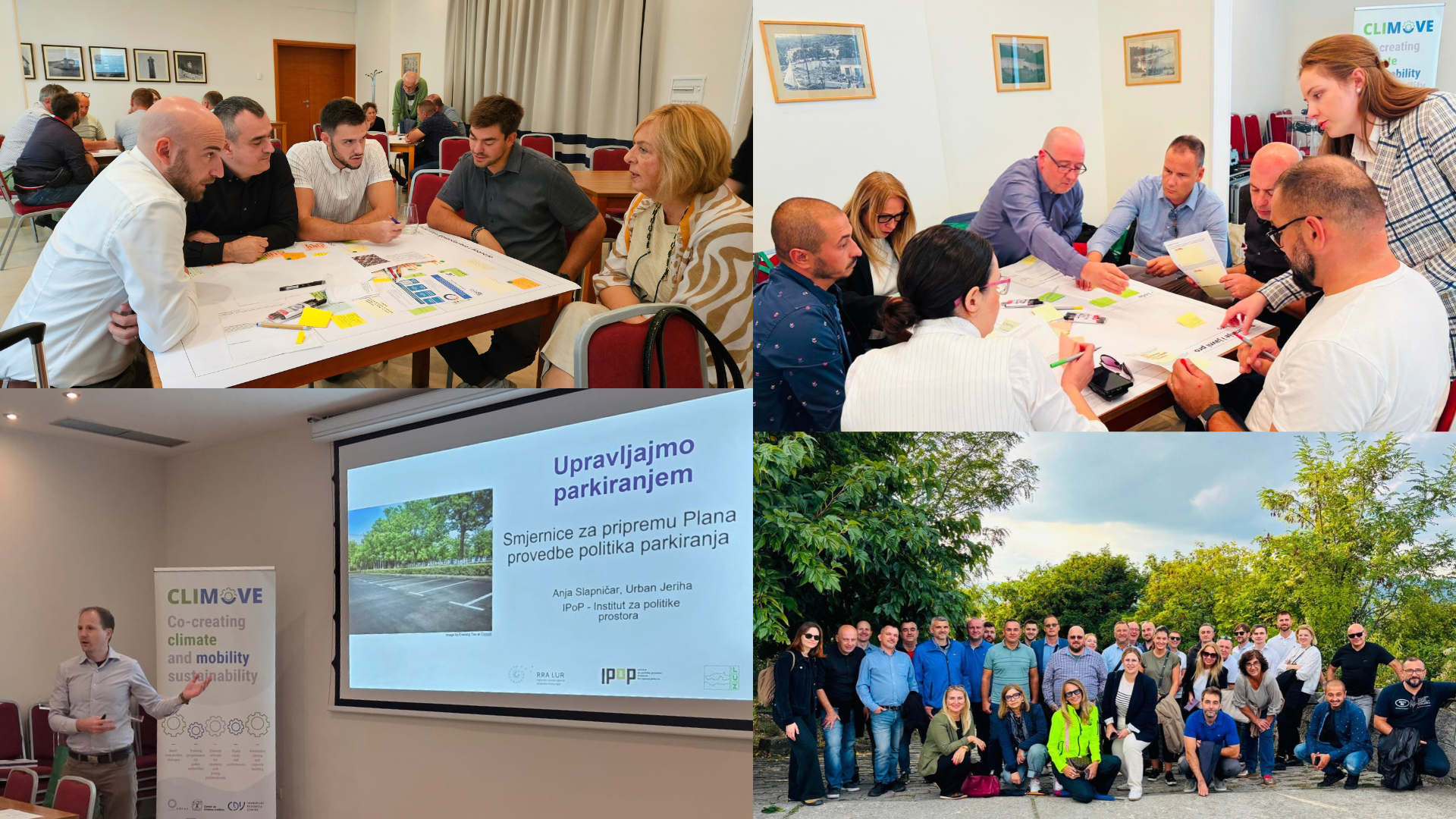
A workshop titled “How Much Parking Is Enough? Parking Policies and the Future of Public Space” was held in Labin from 7 to 8 October 2026, organised by ODRAZ in cooperation with the City of Labin. The workshop brought together more than 45 participants, including representatives of cities, local committees, spatial planning institutes, municipal and public companies, and experts in transport and spatial planning.
The aim of the workshop was to familiarise participants with parking policies as an important tool for managing mobility, public space and the sustainable development of cities, and to empower them to apply these policies in their local contexts.
Parking policies encompass the ways in which parking and available parking spaces are managed, and represent an important tool for influencing travel habits, managing public space and planning sustainable mobility. The way cities organise parking affects land use, access to different amenities and citizens’ quality of life. It is therefore important to consider parking within the broader context of transport and spatial planning and to develop measures that respond to local needs and contribute to creating more sustainable cities.
Day 1 – Strategic Framework for Parking Policies and Study Visit
The first day of the workshop began with a discussion on the paradigm shift in transport planning and the importance of linking transport and spatial planning. Goran Lampelj (ODRAZ) highlighted the broader context of mobility planning and the need for a comprehensive approach to managing transport and public space.
The session continued with Urban Jeriha, an architect, researcher and consultant in sustainable urban development and mobility, and Director of the Institute for Spatial Policies (IPoP) in Ljubljana, who introduced participants to the topic of parking management. Through discussion and group work, participants reflected on the activities undertaken to date in their cities and organisations, mapped existing parking policy measures, and exchanged experiences regarding their impact on public spaces, mobility, the economy and finances, and quality of life in the city. Participants highlighted several key challenges and opportunities for improvement:
- Public space: Cars occupy space intended for pedestrians, greenery and social interaction. Converting some parking spaces to other uses can improve quality of life and safety.
- Economy and finance: Parking revenues can fund public transport and public space improvements, but transparent spending and consideration of local businesses’ needs are essential.
- Transport: Heavy reliance on cars puts pressure on existing infrastructure. Integrating parking with public transport, cycling and walking can reduce pressure on city centres.
- Society and safety: Parking rules should take different users’ needs into account, prioritising safe and unobstructed pavements and a fairer allocation of parking spaces.
The main obstacles to change identified included drivers’ habits, insufficient enforcement, outdated infrastructure, and political and economic resistance. Successful implementation requires citizen participation, clear communication and transparent management.
The day concluded with a study visit to Labin and Rabac, during which participants, accompanied by Dalibora Zupičića (Labin 2000 d.o.o.), analysed the characteristics of the local parking system and discussed existing challenges, needs and plans for improvement. The field visit enabled participants to connect the topics addressed during the workshop with real-life situations and raised questions about how parking policies can contribute to better public space organisation and more sustainable mobility.
Day 2 – Steps in Developing a Parking Policy
The second day of the workshop in Labin focused on the key steps in developing a parking policy. Urban Jeriha (IPoP) discussed how to move from analysing the existing situation and collecting data towards defining objectives, measures and concrete steps for developing parking policies. We discussed what we need to know to understand the parking situation, from occupancy rates and parking space usage to citizens’ needs and perceptions. Particular emphasis was placed on the importance of linking data with participatory decision-making.
During a practical exercise, participants used the example of Labin to explore parking from the perspectives of different users and decision-makers. Although different groups have different needs, the exercise raised questions relevant to parking planning in any city or settlement. The discussion resulted in the following general recommendations:
- Plan according to people’s needs, not just the number of cars.
- Distinguish between the needs of residents, employees and visitors.
- Put safety and accessibility at the centre of planning.
- Integrate parking with other modes of transport.
- Treat public space as a valuable, shared resource.
- Involve citizens before making final decisions.
- Ensure effective enforcement and transparent management.
- Introduce changes gradually and evaluate their impact.
CONCLUSION
The discussion showed that a good parking policy is not merely a matter of organising parking spaces, but also of safety, accessibility, fairness and how public space is used. Planning successful solutions requires linking transport planning with residents’ needs, the local economy and the quality of public space. Data collection, citizen participation, transparent management and monitoring results make it possible to base decisions on actual needs rather than assumptions or pressure to increase the number of parking spaces.
The workshop was organised as part of the CLIMOVE project funded by European Climate Initiative (EUKI) under the Federal Ministry of the Environment, Climate Action, Nature Protection and Nuclear Safety (BMUKN).