

Study Visit to Brussels and Ghent: From European Policies to Concrete Solutions for Cities
The study visit to Brussels and Ghent took place from 14 to 17 April 2026. Its main objective was to strengthen the knowledge and capacities of city representatives and other stakeholders in the fields of sustainable urban mobility and climate neutrality. The study visit brought together 32 participants from Croatia, the Czech Republic, Slovakia, and Bosnia and Herzegovina, including representatives of cities, institutions, civil society organisations, and experts in transport and spatial planning.
The programme included meetings with representatives of European institutions, exchange of experiences with leading European networks and organisations, and insights into concrete examples of good practice, with a particular focus on mobility transformation in Brussels and Ghent.
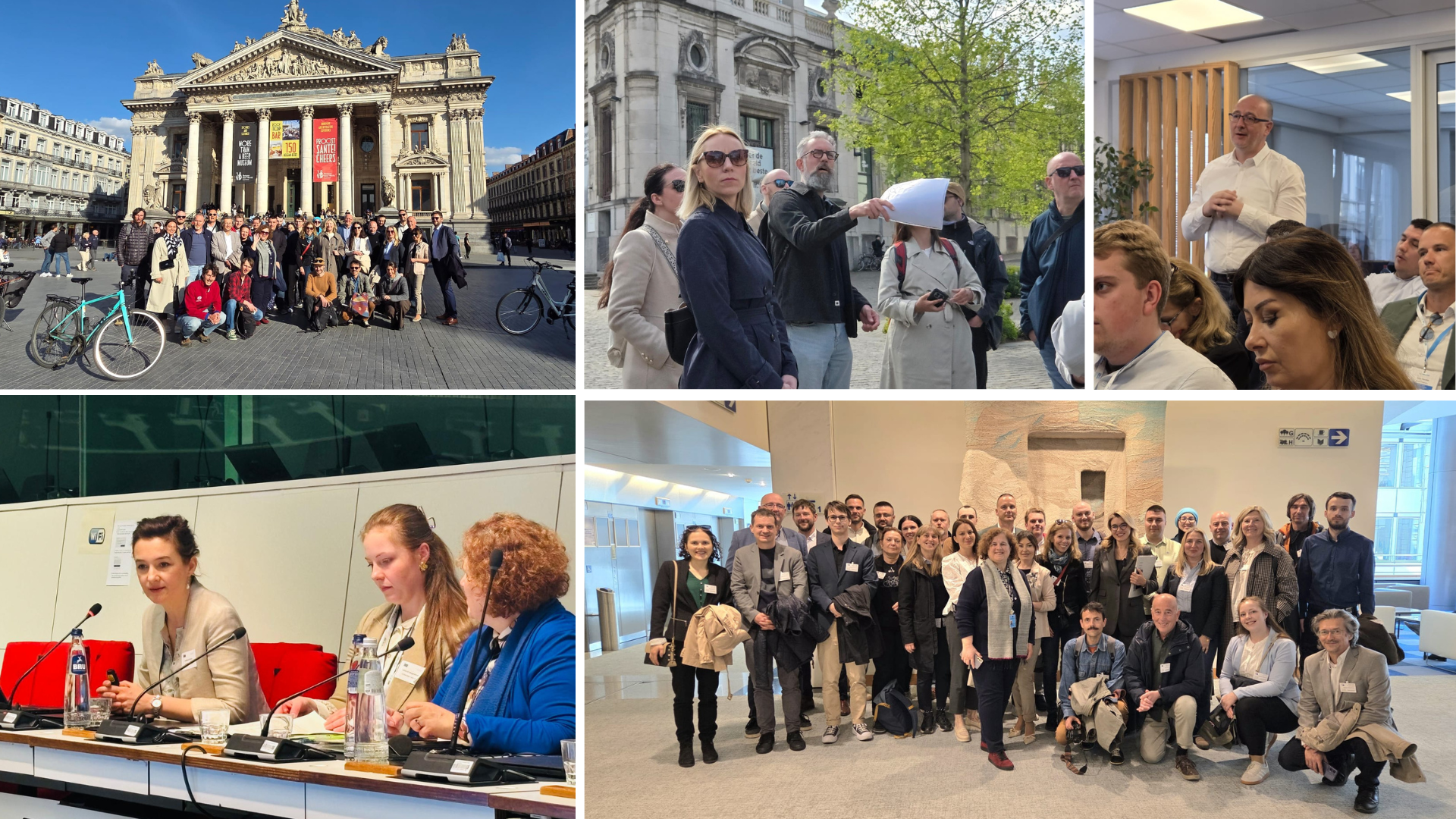
Day 1: The Role of European Policies and Local-Level Challenges
The study visit began at the European Parliament with a meeting with Nikolina Brnjac, Member of the Committee on Transport and Tourism. The discussion opened key questions regarding the link between European policies and their implementation at the local level.
One of the main challenges identified was the lack of an integrated approach – mobility is still often planned separately from spatial development, housing, energy, and social policies. Participants highlighted that while tools such as SUMPs exist, they often fail to address functional urban areas and the broader context of everyday mobility, particularly in suburban zones.
The need for stronger multi-level coordination between local, regional, and national levels was also emphasised, as well as the importance of more direct communication between cities and European institutions.
The day concluded with an expert-led walking tour of Brussels. Thomas Deweer from Fietsersbond presented concrete spatial transformations, from reducing car traffic in the city centre, introducing low-traffic zones and school streets, to reallocating public space in favour of pedestrians and cyclists. These interventions clearly demonstrated how mobility changes directly contribute to improved quality of life and public space in Brussels.
Day 2: From Policy to Practice – What Lies Ahead for Cities?
The second day of the study visit was organised in partnership with the European Economic and Social Committee (#EESC), through a thematic session dedicated to the future of sustainable urban mobility and climate policies.
Participants were welcomed by Marcin Nowacki, President of the #TEN Section of the EESC.
Pedro Homem de Gouveia from POLIS delivered an inspiring keynote presentation.
Matej Žganec from DG MOVE (Directorate-General for Mobility and Transport) outlined what lies ahead for cities – faster and more intensive implementation of sustainable urban mobility through cleaner transport, improved connectivity, and alignment of local plans with European climate goals.
Octavia Stepan and Yannick Bousse from the European Climate, Infrastructure and Environment Executive Agency (CINEA) presented how Horizon Europe and Cities Mission projects are translating policy into tangible results.
Lucy Tober from the European Committee of the Regions (CoR) shared the CoR perspective on EU mobility policies and upcoming developments within the next Multiannual Financial Framework (MFF).
Lidija Pavić-Rogošić, rapporteur for the EESC opinion on “Sustainable Urban Mobility Planning in the EU”, together with co-rapporteur Mateusz Szymański, presented the key recommendations from the opinion.
Marko Stančec from POLIS spoke about connecting the TEN-T network in practice, focusing on urban nodes, SUMPs, and Urban Mobility Indicators (UMIs).
The discussion focused on how cities can accelerate and improve the implementation of climate and mobility policies, with stronger support from EU instruments, partnerships, and innovation. Participants gained valuable insights into EU goals, policies, and financial instruments in the fields of climate and transport.
A strong emphasis was placed on the social dimension of mobility – behavioural change was recognised as a key prerequisite for a successful transition. Mobility is not only a technical issue, but also requires providing real alternatives and a “menu of choices” for citizens, while addressing transport poverty.
Day 3: How Ghent Changed the Way People Move
The city of Ghent represents one of the most well-known European examples of urban mobility transformation.
The group was hosted by Merijn Gouweloose from the Department of Mobility.
Through a presentation at City Hall and a site visit, participants were introduced to the key success factors:
- long-term vision and political continuity,
- strong institutional structure and capacities,
- integrated planning of mobility and urban development,
- decisive implementation of measures, including the reallocation of space.
The introduction of the circulation plan in 2017 demonstrated how changes can be implemented quickly and effectively – traffic was redirected to the ring road, while the city centre was significantly relieved of car traffic. The results include a substantial reduction in car use, an increase in cycling, and improvements in air quality and safety.
The city has also systematically used parking policy as a tool for managing mobility, alongside continuous investments in cycling infrastructure, public transport, and innovative solutions.
Day 4: European Initiatives and Future Trends
The final day of the study visit was dedicated to exchange with representatives of leading European networks and organisations.
Participants had the opportunity to hear from Mélanie Bourgeois from Energy Cities, who presented key trends in European climate and energy policies and their impact on future financing opportunities for cities.
Ivona Malbašić and Andrea Accorigi from Ecorys presented the European Climate Pact and the Circular Cities and Regions Initiative, focusing on stakeholder engagement, capacity building, and support for cities in implementing climate actions.
Davide Sabbadin from the European Environmental Bureau outlined the European framework for decarbonising buildings in the context of the current energy crisis, highlighting both challenges and opportunities for cities in improving energy efficiency.
Lottie Stainer from UITP discussed the role of public transport in achieving climate neutrality, through the Avoid–Shift–Improve approach and the need to strengthen sustainable mobility options.
Philip Amaral from the European Cyclists’ Federation presented EU policies and initiatives aimed at promoting cycling and increasing its role in everyday mobility.
Vanessa Holve from ICLEI reflected on the role of cities and international networks in implementing climate and mobility policies, emphasising the importance of integrated solutions and stakeholder cooperation.
A strong emphasis was placed on the importance of an integrated approach, connecting different sectors and governance levels, as well as on strengthening the capacities of cities to make effective use of available EU funding and instruments.
The session concluded with participants reflecting on the key takeaways from the study visit and defining concrete next steps for applying the lessons learned in their respective cities.
Key conclusions of the study visit:
- Sustainable urban mobility requires an integrated approach, linking mobility with spatial planning, housing, energy, and social policies.
- The main challenge is not the lack of solutions, but their implementation – there is a significant gap between strategies, pilot projects, and real-world application.
- SUMPs are an important tool, but they are often insufficiently implemented and poorly aligned with other plans and functional urban areas.
- Multi-level cooperation is essential – stronger coordination between local, regional, national, and EU levels is needed.
- Behavioural change is a key prerequisite for the transition – mobility is primarily a social, not only a technical challenge.
- City capacities, especially in smaller municipalities, are often limited – investment in knowledge, data, and administrative capabilities is needed.
- Funding is available but not used efficiently enough – better alignment with EU programmes and more strategic use of resources is required.
- Examples such as Ghent show that rapid and concrete changes are possible, with strong political will, a clear vision, and readiness to reallocate public space.
The study visit was organised by ODRAZ – Sustainable Community Development in cooperation with the Center for Environment (Banja Luka) and the Transport Research Centre (Brno).
The study visit is part of the CLIMove project, funded by the European Climate Initiative (EUKI) of the German Federal Ministry for Economic Affairs and Climate Action (BMWK).