

Young Professionals Developed Solutions for Sustainable Urban Mobility in Šibenik
The final event of the CLIMove Summer School was held on 24 July 2026, from 10 a.m. to 2 p.m at St. John’s Fortress in Šibenik under the title “Coastal Cities Mobility Renaissance – Insights from Young Professionals: Case Study Šibenik.”
The event placed a particular emphasis on applying STEM knowledge to real-life challenges faced by coastal cities. The event presented the results of international teams of students and young professionals from Croatia, Bosnia and Herzegovina, the Czech Republic and Slovakia, who developed proposals for more sustainable mobility and higher-quality public spaces in Šibenik. It brought together summer school participants, mentors, representatives of local stakeholders and guests interested in sustainable mobility, urban development and the application of STEM knowledge to real urban challenges.
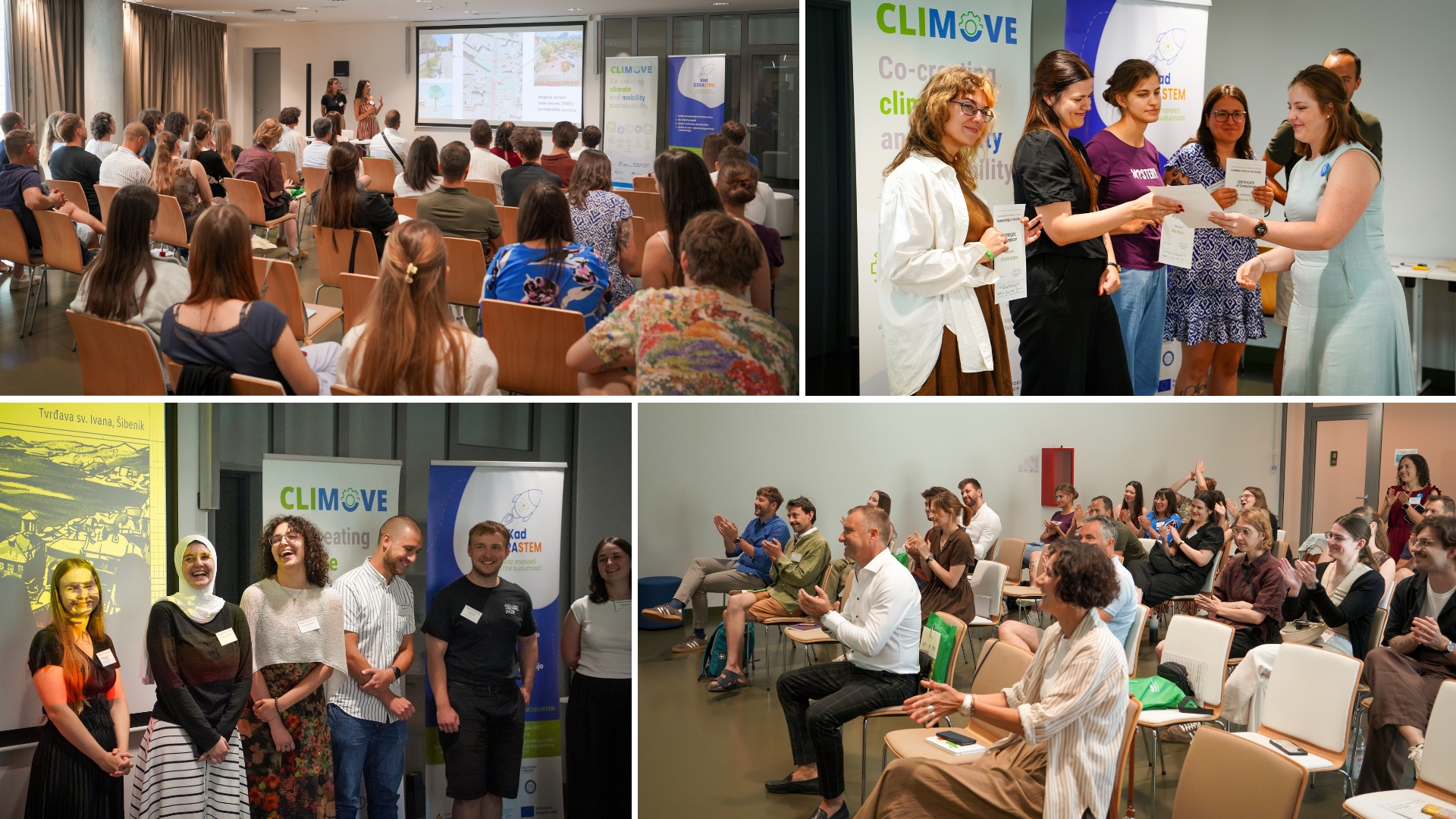
The aim of the final event was to present the results of the interdisciplinary teams’ work and open a discussion on the importance of connecting STEM fields, different professions and the needs of public-space users. During the summer school, participants combined data analysis, field research, design thinking and teamwork. In this way, they connected professional knowledge with the specific local context and the everyday experiences of citizens.
Presentation of solutions
The teams presented proposals for improving mobility and public space in Šibenik. The solutions were developed based on field observations, conversations with users, analysis of the current situation and collaborative work by students and young professionals from fields ranging from architecture to sociology.
The presentations of the summer school participants’ solutions were followed by an evaluation committee consisting of:
- Kristina Perkov – Senior Advisor at the Public Institution Institute for Spatial Planning of Šibenik-Knin County, and a mentor at the summer school.
- Ivana Kardum Goleš, PhD – Vice Dean for Scientific and Professional Work and International Cooperation at the University of Applied Sciences in Šibenik.
- Goran Bulat – Director of Gradski parking d.o.o. Šibenik.
Enhancing Climate Resilience of Šibenik
Roko Uvodić, Lamija Omerbegović, Lamija Čabaravdić, Daniel White and Júlia Sedláková presented a proposal for increasing Šibenik’s climate resilience through a three-phase implementation process. Their solutions included green pergolas, street canopies, solar shading structures and a water collection system, as well as a model they designed themselves.
Inclusive Public Space: Rethinking the Riva, Šibenik
Petra Malinská, Klára Zoufalá, Alma Peco, Ivan Pelčić and Gorana Bučević presented a proposal for a more inclusive Šibenik waterfront, focused on removing barriers and creating public space accessible to all users. In addition to more accessible pedestrian crossings, removing obstacles to movement and harmonising infrastructure interventions, they also proposed a concrete implementation plan with a strong focus on citizen participation.
Urban Link: Šibenik’s Multimodal Hub
Gabriela Kalle, Ivana Halavuk, Laura Vresk, Hana Šabanagić and Sebastian Macura presented a proposal for a multimodal transport hub in Šibenik, aimed at better connecting bus, rail and maritime transport. They proposed shorter and more accessible transfers, connecting the upper and lower promenades, expanding the railway station and introducing a more coordinated timetable, with the aim of making travel easier and encouraging greater use of sustainable mobility.
YoUlica: Living street – street as a place for all
Mia Brkić, Rea Sutović, Naida Smajlović, Šimon Jelínek and Valeriia Zelinová focused on reclaiming public space for people and creating a safer, greener and more pleasant Fra Jerolima Milete Street. They proposed reducing space for cars, widening pedestrian areas, introducing cycling infrastructure and parklets, adding more greenery, lighting and seating, and applying nature-based solutions.
Ctrl + S treets: Living street – street as a place for all
Aiša Muhić, Jakub Kremser, Petra Pažin, Kristina Karpov and Andrea Iva Pašić presented the concept of an adaptive living street, aimed at creating more flexible public spaces that respond to different users, times of use and activities. They proposed transforming parts of Ante Starčevića Street and Ante Šupuka Street into spaces for waiting, learning and spending time.
Panel on the value of summer schools
The event continued with a panel discussion on the benefits of summer schools and non-formal education, featuring members of the evaluation committee.
Ivana Kardum Goleš highlighted that programmes of this kind, in addition to professional knowledge, help develop soft skills, communication and teamwork abilities. A transdisciplinary approach enables participants to encounter different perspectives and gain a better understanding of other professions.
Such work also helps to “demystify” individual disciplines by showing how knowledge from science, technology, engineering and mathematics can be connected with the social and spatial aspects of urban development. Kristina Perkov emphasised that understanding how people experience space was the most important criterion when evaluating the students’ work.
The ŠI@ALL app was presented
The ŠI@ALL app was also presented at the event as an example of using digital technologies and data to improve access to information and the experience of moving through and using the city. The app was presented by Jelena Jurić from the Department of Economy, Entrepreneurship and Development of the City of Šibenik, and was funded through the SPINE project.
The app demonstrates how STEM solutions can respond to the concrete needs of citizens and contribute to a more accessible and inclusive urban environment.
Conclusion
“Interdisciplinarity does not produce the best results by itself. Learning how to work between disciplines is what’s important.” – Ivana Kardum Goleš
The final event demonstrated what can be achieved when young people from different professional backgrounds work together on real local challenges. The summer school enabled participants to apply professional and STEM knowledge in practice, develop communication and teamwork skills, and become familiar with different ways of thinking. Cooperation, the exchange of perspectives and the connection of disciplines are key prerequisites for planning more sustainable cities of the future.
The event was organised as part of the CLIMove project, funded by the European Climate Initiative of the German Federal Ministry for the Environment, Climate Action, Nature Conservation and Nuclear Safety (BMUKN); the SPINE project, funded under the Horizon Europe Research and Innovation Programme under Grant Agreement No. 101096664; and the Kad ODRASTEM project, co-funded by the European Union through the European Social Fund Plus (ESF+) – Strengthening the capacities of civil society organisations for STEM popularisation (85%) and the State Budget (15%).
The views and opinions expressed are those of the author(s) only and do not necessarily reflect the official position of the European Union or the European Commission. Neither the European Union nor the European Commission can be held responsible for them.