

Quality communication is the foundation for the successful implementation of climate and transport policies
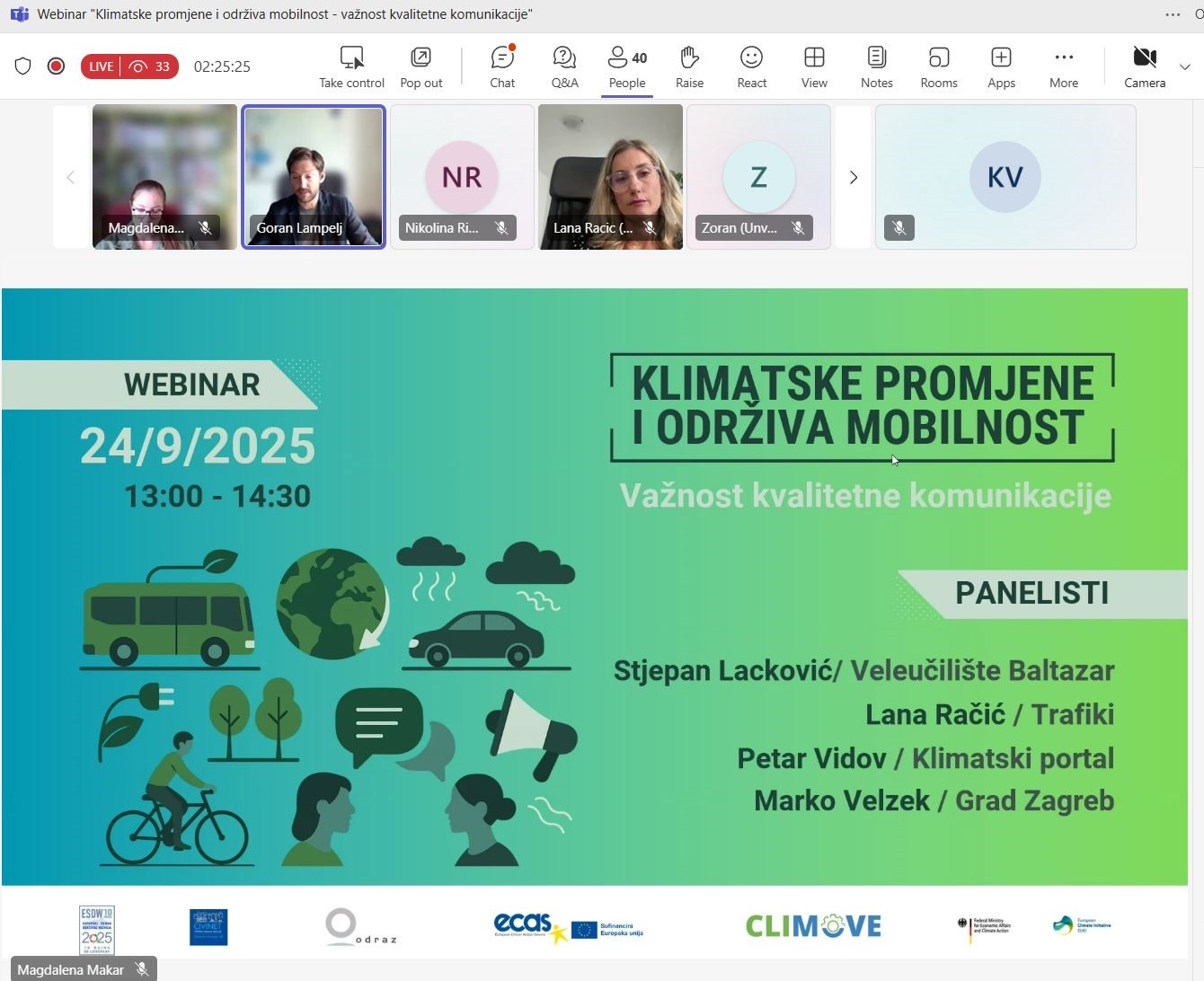
Disinformation is an obstacle to the climate transition — and the solution is to build trust through accurate information. This was precisely the focus of the webinar “Climate Change and Sustainable Mobility – The Importance of Quality Communication,” held on 24 September 2025 and organized by ODRAZ. The event brought together around 40 participants — experts in sustainable mobility, communications, journalism, science, and local government — with the aim of highlighting the impact of disinformation on the public’s understanding of climate change and sustainable mobility.
The webinar was organized as part of the European Sustainable Development Week, an initiative that encourages public debate and joint action in line with the Sustainable Development Goals. The aim was to show how to recognize disinformation, which information sources can be considered reliable, and why critical thinking matters.
Disinformation – an obstacle to the climate transition
In the opening segment, Magdalena Makar (ODRAZ) presented the most common forms and motives behind the spread of disinformation, following the classification of the Agency for Electronic Media and UNICEF. She explained how disinformation, misinformation, and malinformation arise and how they affect citizens’ trust in science, institutions, and public policies. She particularly highlighted claims that undermine understanding of the existence of climate change, portray public transport negatively, or encourage skepticism toward electric vehicles and sustainable mobility. She emphasized that quality, verified, and clear communication is crucial for building a resilient and well-informed society.
Panel discussion – building trust through accurate information
The panel featured Lana Račić (Trafiki), Marko Velzek (City of Zagreb), Petar Vidov (Climate Portal) and Stjepan Lacković (Baltazar Polytechnic).
The panellists jointly emphasized that quality communication is the foundation for the successful implementation of climate and transport policies. In a society that faces a flood of information every day, it is crucial to identify credible sources and learn to distinguish science-based facts from manipulative content.
They stressed that transparent, timely and two-way communication between institutions and citizens is essential for building trust and for acceptance of the changes brought by the green transition.
Special emphasis was placed on developing media literacy throughout the education system — from primary schools to universities — so that future generations become more resilient to disinformation and more critical of the content they consume daily through the media and social networks.
The panellists agreed that changes in habits — such as reducing the use of private cars, switching to sustainable modes of mobility, and applying sustainability in everyday life — take time, consistent communication, and clearly explained benefits for citizens.
It was concluded that institutions, experts and the media should jointly build a culture of trust in which information is fact-based and dialogue with the public becomes an ongoing process, not merely a reaction to crisis situations. Only such an approach can ensure long-term public support for climate and sustainable policies.
In conclusion:
-
Disinformation seriously slows down the climate transition and creates distrust in institutions.
-
Education and media literacy are key to a resilient society.
-
Children and young people should be included in decision-making processes, encouraged to develop critical thinking, and to learn about sustainable development.
-
Institutions and experts should communicate clearly, in two directions, and with an understanding of citizens’ needs.
-
Changes in social habits require patience, consistency and trust — built through open dialogue.
A video recording of the webinar is available HERE.
The webinar was organized as part of the project Media Literacy and Digital Citizens, financed by the European Citizen Action Service (ECAS) within the EURECA 2025 project. The project is co-financed by the European Union. The views and opinions expressed are solely those of the authors and do not necessarily reflect those of the European Union or ECAS. Neither the European Union nor ECAS can be held responsible for them.
The webinar was also organized within the CLIMove project, financed by the European Climate Initiative (EUKI) at the German Federal Ministry for Economic Affairs and Climate Action (BMWK).