

Coastal Cities Mobility Renaissance – Insights from Young Professionals: Case Study Šibenik
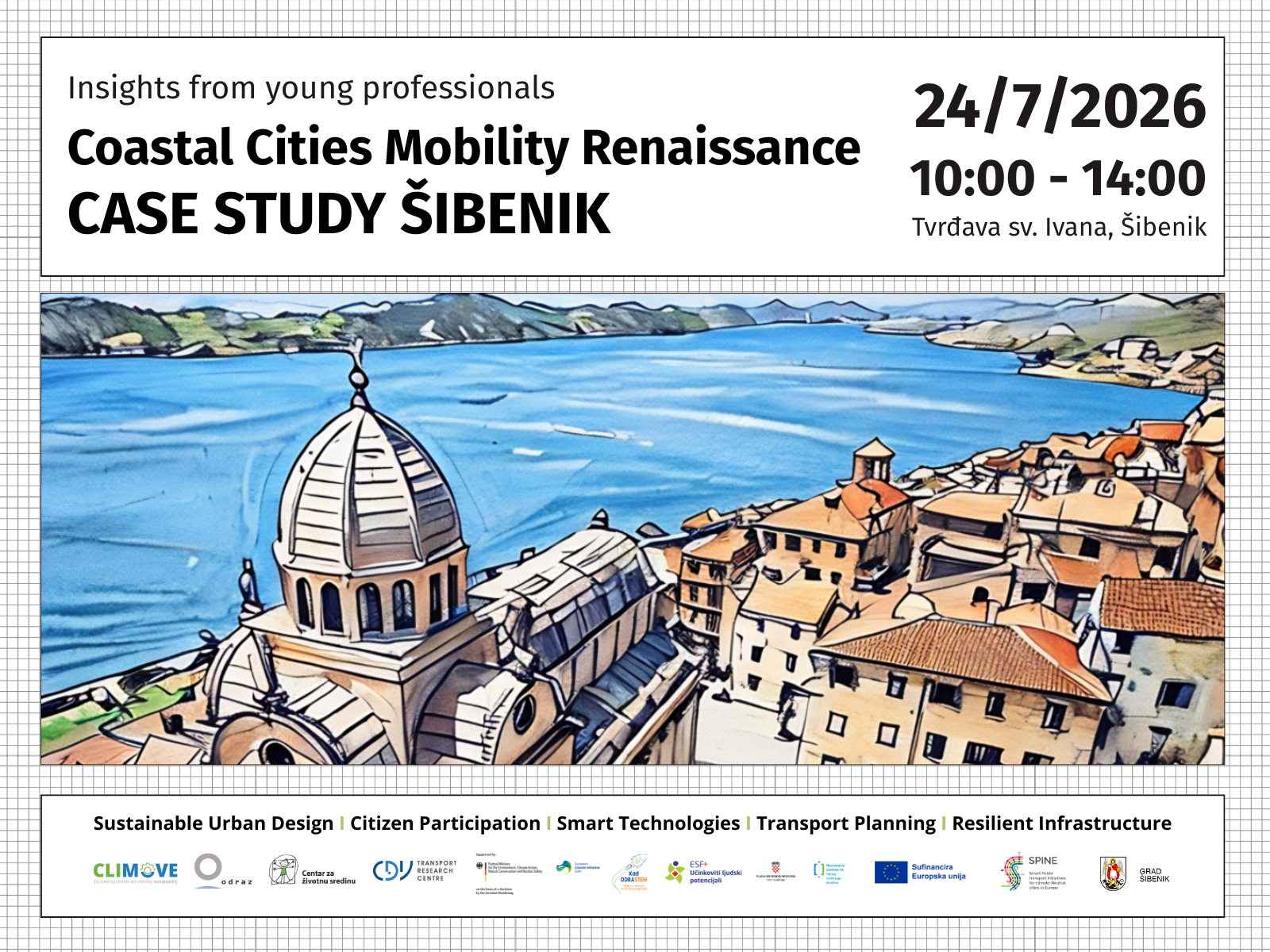
Join us this summer for the Summer School final event “Coastal Cities Mobility Renaissance – Insights from Young Professionals: Case Study Šibenik”, which will take place on 24 July 2026, from 10:00 to 14:00, at St. John’s Fortress in Šibenik. Special emphasis will on the application of STEM knowledge in addressing real city challenges. Everyone is welcome! Please register by 22 July 2026.
Are you interested in how young professionals from an international Summer School imagine the future of mobility and public spaces in Šibenik? At the event, international teams of students and young professionals from Croatia, Bosnia and Herzegovina, Czechia and Slovakia will present the results of their work. They will share concrete proposals focusing on climate-neutral mobility, the quality of public space, inclusiveness, multimodality and green technologies and demonstrate how STEM knowledge can be applied to solving real coastal city challenges.
What can you expect?
As in previous editions of the Summer School, the aim is to provide young people with an opportunity to learn by working on real urban challenges, while encouraging cooperation between students, mentors, local government and other stakeholders.
During the Summer School, interdisciplinary teams will develop conceptual solutions that can serve as inspiration for further work on sustainable mobility and public spaces in Šibenik, as well as in other coastal cities.
The topics they will work on during the school are related to the intermodal transport hub, inclusive mobility and public spaces, living streets, micromobility, climate resilience and reducing car dependency.
Citizens will have the opportunity to ask questions and take part in a discussion on how Šibenik can become a more pleasant city for everyday life and young people will be able to learn how STEM disciplines contribute to the development of more sustainable coastal cities.
A special part of the programme will be dedicated to the presentation of the ŠI@ALL application, a journey planner developed within the SPINE project, which enables citizens and visitors to plan their movement around Šibenik more easily and make better use of the available transport options.
How to register?
Please register by 22 July 2026 via the following link:
https://forms.gle/v6Ao3d3dYDue4yvz9
Who is the event for?
The event is open to everyone interested in hearing how young professionals see the future of mobility in coastal cities, taking part in the discussion and contributing to the reflection on Šibenik as a more accessible, inclusive and pleasant city.
Pupils, students, teachers, representatives of STEM faculties and all young people interested in transport, urban planning, architecture, climate change, digital solutions, green technologies and sustainable development are especially encouraged to attend.
If you are interested in STEM fields and would like to see how knowledge from science, technology, engineering and mathematics can be applied to real urban challenges, this is an opportunity to get involved, ask questions and learn more about ODRAZ’s CLIMove, SPINE and Kad ODRASTEM projects.
Participation is free of charge and open to all, with prior registration.
The event will be held in English.
The event is organised as part of the CLIMove project, funded by the European Climate Initiative under the German Federal Ministry for the Environment, Climate Action, Nature Conservation and Nuclear Safety (BMUKN), the SPINE project, funded under the Horizon Europe research and innovation programme under Grant Agreement No. 101096664, and the Kad ODRASTEMproject, co-financed by the European Union from the European Social Fund Plus (ESF+) – Strengthening the capacity of civil society organisations for the popularisation of STEM (85%); State Budget (15%).
The views and opinions expressed are those of the author(s) only and do not necessarily reflect the official views of the European Union or the European Commission. Neither the European Union nor the European Commission can be held responsible for them.