

It is important to teach young people to ask questions and not just look for answers: a webinar was held on media literacy and misinformation
More than 60 participants, including teachers, professional associates, representatives of civil society organizations and other interested citizens, gathered on October 21, 2026, at the webinar “Fact. Or not?” to discuss media literacy, disinformation, climate literacy and the challenges brought by the development of artificial intelligence with experts from the fields of science, media, education and civil society.
The webinar was moderated by Magdalena Ribarić from ODRAZ, who presented the Resilient Community project and activities implemented to strengthen citizens’ information resilience to the participants. Special emphasis was placed on working with young people through workshops, debate activities, the educational online campaign “Recognize. Check. Decide.” and the podcast
Media literacy as a tool for active participation in society
The opening speech was given by Žarko Čižmar, founder and director of Telecentar and head of the Media Lab at Algebra Bernays University. Čižmar spoke about the development of media literacy and its role in modern society. He emphasized that media literacy is not only the ability to recognize fake news and disinformation, but also the ability to understand media content, assess its credibility, and participate responsibly in the public space.
Speaking about approaches to media literacy, he distinguished between a protective approach, focused on recognizing manipulation and disinformation, and an empowering approach, which encourages citizens to think critically, create responsible content, and actively participate in democratic processes.
During the lecture, participants participated in interactive surveys using the Mentimeter tool. They indicated that the most common way to verify suspicious information is to check sources and compare information from multiple sources. At the same time, they recognized the lack of interest in additional research and verification of information as one of the greatest obstacles to the development of critical thinking.
How to build trust in science?
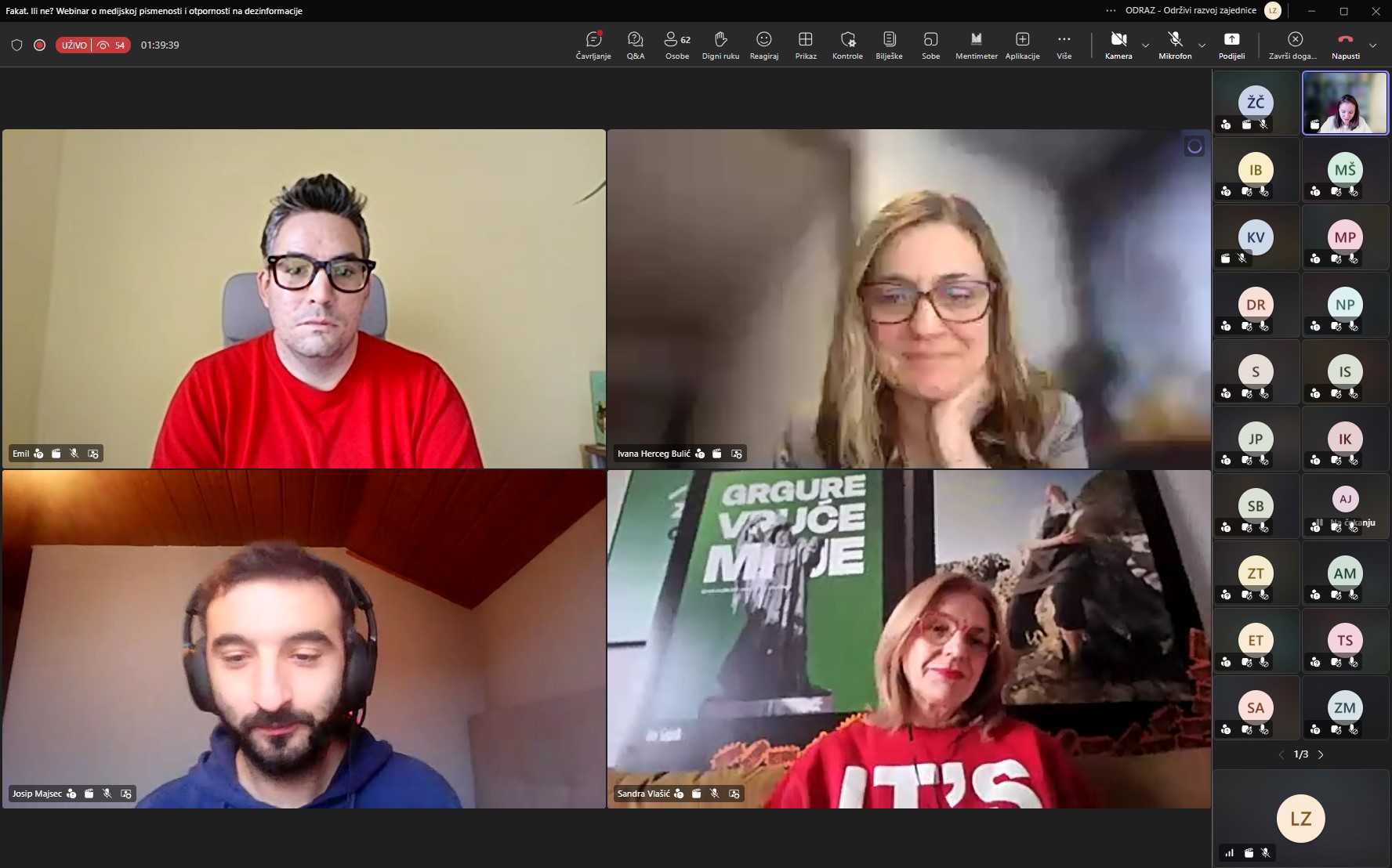
The central part of the webinar was a panel discussion with the participation of Ivana Herceg Bulić from the Department of Geophysics, Faculty of Science, University of Zagreb, Sandra Vlašić from Terra Hub, independent investigative journalist Emil Čančar, and Josip Majsec from the Croatian Debate Society.
Speaking about scientific information and trust in science, Ivana Herceg Bulić emphasized that the credibility of scientists is not based only on their titles, but primarily on their research work, published and peer-reviewed scientific papers, and the quality of the arguments they present.
She particularly drew attention to the responsibility that young people feel when it comes to climate change: “Young people feel that they need to fix something that we adults have messed up.”
She emphasized that this is precisely why young people need to be provided with knowledge, tools, and support so that they can understand complex social and environmental challenges and actively participate in solving them.
Climate Literacy and a Sense of Personal Responsibility
Sandra Vlašić from Terra Hub spoke about the importance of climate literacy, or, as she pointed out, a kind of climate literacy of citizens, the media, the education system and decision-makers. She emphasized that understanding climate change requires developing knowledge about the complex processes and phenomena that shape today’s society and affect the lives of current and future generations.
As an example of an approach that connects knowledge, research and creativity, she presented the project “Terrapija – We Heal the Earth with Education“, which Terra Hub is implementing in collaboration with media design students. Through the project, students explore various topics related to the climate crisis and interpret them through visual works, from climate vocabulary and the Paris Agreement to food waste, consumerism, fast fashion and the impact of heat waves on everyday life.
She emphasized that actively exploring problems and searching for possible solutions can help overcome feelings of helplessness and climate anxiety. According to her, engagement, understanding the problem, and recognizing one’s own role in change are important steps towards a more resilient and informed society.
Media, disinformation and artificial intelligence
Journalist Emil Čančar addressed the challenges facing the media today. He pointed out that the accelerated pace of content production and the pressure on journalists often make it difficult to thoroughly verify information and provide quality reporting on complex topics such as climate change.
The discussion also raised the issue of the increasing presence of artificial intelligence in education and everyday life. Ivana Herceg Bulić pointed out that artificial intelligence already plays a significant role in scientific research and the processing of large data sets, for example in meteorology and climatology. However, she emphasized that its results should always be viewed through the prism of human knowledge, experience and critical thinking. As a teacher, she does not prohibit students from using artificial intelligence tools, but she expects them to understand the processes and conclusions they reach and to be able to explain them with arguments. She emphasized that the development of critical thinking is crucial for the responsible use of new technologies.
Debate as a School of Critical Thinking
Josip Majsec from the Croatian Debate Society spoke about the role of debate in the development of media literacy. He explained how debates encourage young people to research sources, check facts, present arguments and understand different perspectives.
Such an approach, he pointed out, helps develop the skills that are necessary today to navigate a complex information environment and make thoughtful decisions.
Ask questions, check, understand
The panelists agreed that one of the most important tasks of education is to develop in young people the habit of questioning information, checking sources and seeking evidence. Media literacy, it was concluded, is not only the ability to recognize incorrect information, but also an understanding of how information is created, disseminated and influences our decisions.
As highlighted at the end of the webinar, it is important to teach students not only to recognize disinformation, but also to ask questions, compare sources and be ready to reconsider their own positions when facts prompt them to do so.
The webinar was held as part of the Resilient Community project funded by the European Citizen Action Service (ECAS) within the EURECA Plus 2026 project, which is co-financed by the European Union.
The webinar recording is available on the ODRAZ YouTube channel.
Participants are also invited to follow the upcoming episodes of the podcast “Fact. Or not?”, created in cooperation with Radio Student, in which the topics of media literacy, misinformation and climate communication will be discussed.
#ResilientCommunity #Disinformation #ClimateDisinformation #MediaLiteracy #CriticalThinking #InformationResilence #ODRAZ
The views and opinions expressed are solely those of the author and do not necessarily reflect the views of the European Union or ECAS. Neither the European Union nor ECAS can be held responsible for them.