

Rural Proofing and the Right to Stay: Key Messages from the 6th Croatian Rural Parliament
How can European and national policies better reflect the real needs of people living beyond large urban centres? This was one of the key questions discussed at the 6th Croatian Rural Parliament, held in Vinkovci on 29-30 September 2026, where participants explored how policies can better serve rural communities and improve quality of life outside large cities.
Particular attention was drawn to the presentation of the recently adopted European Economic and Social Committee (EESC) opinion on rural proofing, delivered by Lidija Pavić-Rogošić, EESC member and Director of ODRAZ. Discussions focused on the future of rural areas after 2027, the role of young people and women, and the contribution of the LEADER approach to local development.
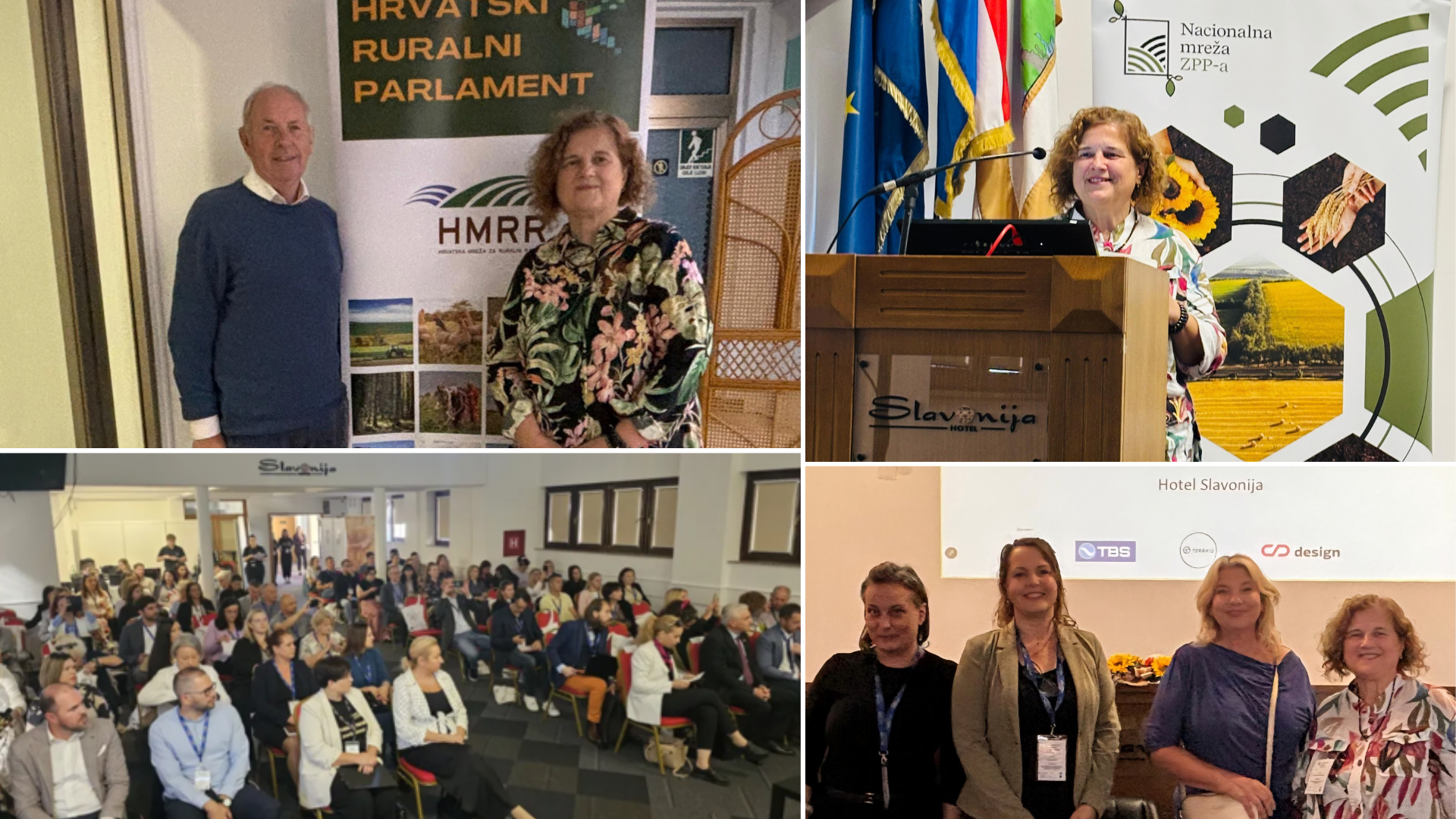
The event brought together representatives of rural communities, Local Action Groups (LAGs), public institutions, farmers, entrepreneurs, researchers and civil society organisations. It was organised by the Croatian Rural Development Network, the LEADER Network Croatia and the National CAP Network, under the patronage of the Ministry of Agriculture, Forestry and Fisheries.
The programme covered the future of the Common Agricultural Policy (CAP) and rural development after 2027, the LEADER/CLLD approach, local community needs, and the position of young people and women in rural areas. In addition to plenary sessions and panel debates, participants took part in a Rural Café, field workshops, presentations of local products and examples of good practice.
Quality of Life Depends on More Than Agricultural Support
In the opening session, Marinko Beljo, State Secretary at the Ministry of Agriculture, Forestry and Fisheries, highlighted the crucial role of young people and women in rural development.
“Women have always been the backbone of Croatian villages, but today they are increasingly becoming drivers of economic change. Young people need more than subsidies; they need a complete living environment, from accessible childcare and schools to modern infrastructure,” Beljo said. He encouraged participants to be both critical and constructive, stressing that the Parliament’s conclusions should guide future national measures and policies..
Kristina Bilić, State Secretary at the Ministry of Regional Development and EU Funds, emphasised that if rural areas are to remain attractive places to live, policymakers must think in long-term terms. “We need to consider where we want our communities to be in 10, 20 or 30 years. Preparations for the post-2027 programming period are already underway, and meetings such as this help us better understand local needs,” she noted.
What Comes After 2027?
Sanja Krnić Bastać from the Ministry of Agriculture, Forestry and Fisheries presented key elements of the new EU Multiannual Financial Framework for 2028-2034 and the concept of National and Regional Partnership Plans (NRPPs), which are expected to integrate the implementation of different EU policies after 2027.
She highlighted three guiding principles for these plans: alignment with EU priorities, responsiveness to national and regional challenges and stronger synergies between EU programmes. She also stressed that horizontal principles such as climate and environmental protection, social rights, gender equality and the “do no significant harm” principle will remain mandatory components of future planning processes.
Rural Proofing as a Prerequisite for Fairer Policies
Presenting the recently adopted EESC opinion on rural proofing, Lidija Pavić-Rogošić, EESC member and Director of ODRAZ, stressed that life in rural areas is shaped not only by agricultural and rural policy but also by decisions in healthcare, education, transport, energy, digitalisation and social services. As rapporteur of the EESC opinion, she underlined that rural areas must be visible across all European Union policies.
Rural proofing refers to the systematic assessment of how public policies affect rural areas before they are adopted. It is a practical tool for making policies more effective and territorially fair
The question “How will this decision affect people who live and work in rural areas?” should become an integral part of policymaking at European, national and local levels.
Referring to the future EU budget after 2027, Pavić-Rogošić emphasised that the rural perspective must become a horizontal principle across all policies and levels of governance. She also argued that rural proofing should be embedded in the preparation and implementation of the proposed National and Regional Partnership Plans (NRPP), requiring Member States to demonstrate how rural impacts have been assessed and addressed.
Speaking about the Right to Stay initiative, she stressed that a person’s place of residence should never determine access to education, public services or employment opportunities. Rural communities are not asking for special treatment, but for equal opportunities and fair access to development. Territorial fairness, she argued, must be built into policymaking from the outset
“Rural proofing only matters if it changes decisions. If we want policies that work for everyone, we need to think rural from the very beginning,” concluded Lidija Pavić-Rogošić.
Rural Proofing and the Right to Stay Must Become Reality
Speaking on behalf of the European Rural Community Alliance (ERCA) and the European Rural Parliament (ERP), Tom Jones linked the discussions in Vinkovci to ongoing European debates on demographic change, territorial cohesion and the future of rural areas after 2027.
He expressed support for the Right to Stay and the Right to Return initiative, emphasising that its implementation will require concrete action from Member States, the active involvement of local communities and civil society, and systematic monitoring of territorial inequalities.
Jones warned that the political momentum created by the EU’s Long-Term Vision for Rural Areas must not be lost after 2027. Strengthening rural proofing, he argued, is essential to ensuring equal access to public services and development opportunities for rural citizens.
Young People Do Not Decide to Stay Based on Subsidies Alone
Discussions on youth highlighted that decisions to stay in, return to or invest in rural communities are influenced by far more than agricultural support schemes. Housing, access to services, transport connections and digital infrastructure are equally important.
An inspiring example was provided by beekeeper Adam Knežević, who successfully expanded his family business to more than 800 beehives, demonstrating how entrepreneurship and innovation can create opportunities in rural areas.
Women Are Driving Rural Change
The panel “Women as Drivers of Change in Rural Areas” highlighted the essential role women play in rural entrepreneurship, tourism, social services and preserving local heritage.
Participants stressed that stronger support mechanisms, including improved access to finance, education and capacity-building opportunities, are still needed to unlock the full potential of women in rural development.
LEADER Gives Communities a Voice
The LEADER/CLLD approach featured prominently in the programme as an example of participatory rural development that places local people at the centre of decision-making.
Local Action Groups (LAGs) bring together municipalities, businesses and civil society organisations, ensuring that development priorities are not determined solely from the top down. However, participants noted that sustainable local development requires more than project funding. Stable institutional capacities, greater trust in local decision-making and fewer administrative burdens are also needed.
The second day of the programme included a presentation of the LEADER Youth platform, aimed at increasing young people’s participation in local development initiatives.
Conclusions: Rural Areas Need Fair Policies, Not Just Funding
The discussions in Vinkovci revealed broad consensus around a simple but important message: rural areas need more than financial support. They need policies that give equal attention to service accessibility, quality of life, community participation and territorial fairness.
As negotiations on the post-2027 EU budget begin to take shape, participants stressed that rural areas should not be viewed solely through the lens of agriculture, but as places where people live, work, innovate and build their futures. In this context, rural proofing and the Right to Stay emerged as two of the most important messages of the 6th Croatian Rural Parliament.
Prepared by: Lidija Pavić-Rogošić, EESC member
#RuralParliament #CroatianRuralParliament #RuralDevelopment #RuralProofing #EESC #ERCA #ERP #LEADER #Women #Youth #RightToStay