

The future of rural areas requires an integrated approach and a stronger voice for local communities
The Forum brought together around 200 representatives of EU institutions, national, regional and local authorities, civil society and other rural development stakeholders. Participants included European Commissioner Michael McGrath, as well as Irish ministers Dara Calleary, Minister for Rural and Community Development and the Gaeltacht, and Martin Heydon, Minister for Agriculture, Food and the Marine. The Forum was organised by the Irish Presidency of the Council of the European Union and the European Commission, with the support of the Rural Pact Support Office. Seamus Boland, President of the European Economic and Social Committee (EESC), presented the civil society perspective and its expectations for the future National and Regional Partnership Plans.
Alongside Lidija Pavić-Rogošić, Croatia was represented by a small delegation that included representatives of the Ministry of Agriculture, Forestry and Fisheries and a councillor from the City of Sisak.
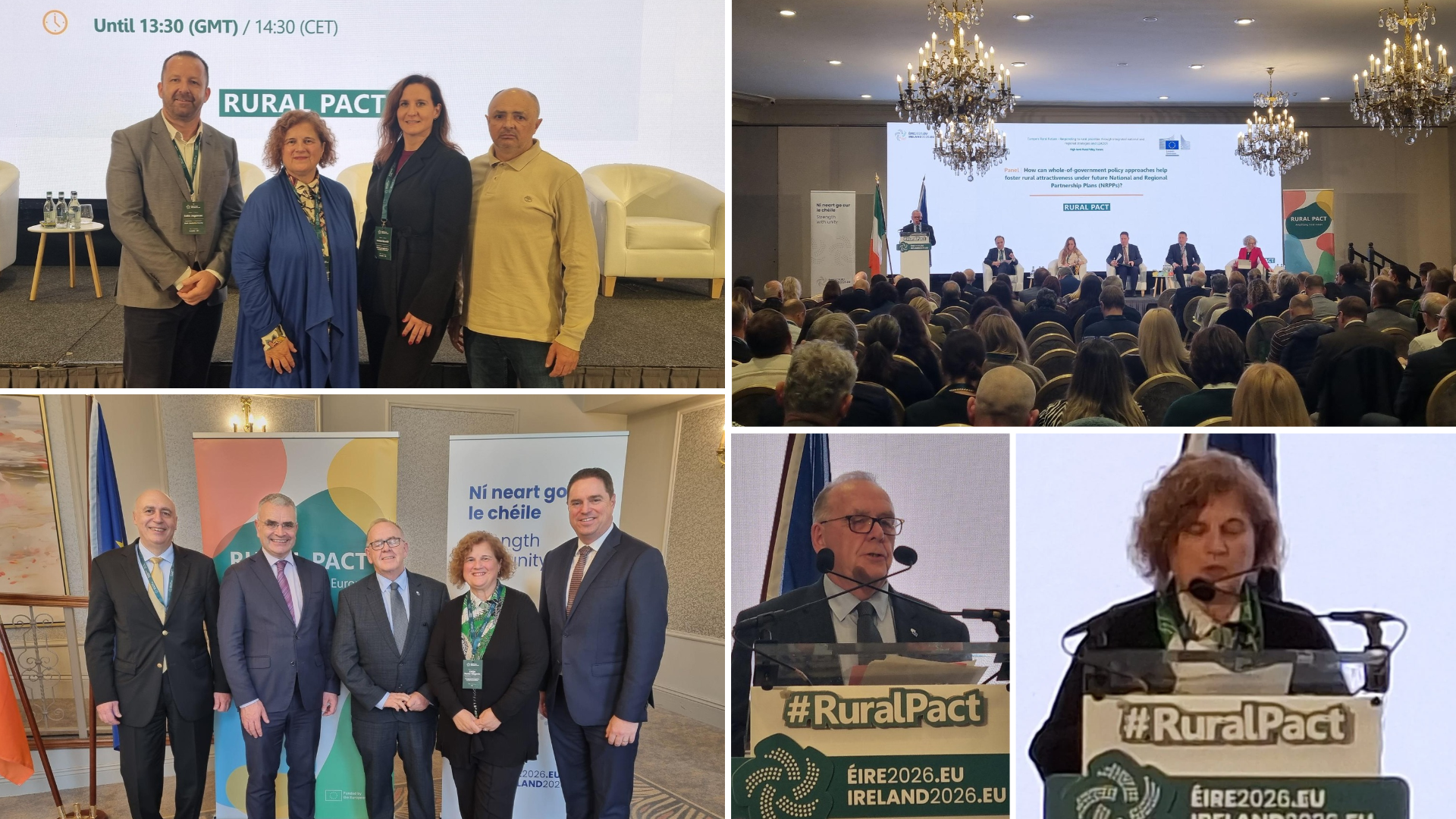
Discussions focused on how to develop integrated rural policies that respond more effectively to the diverse needs and development opportunities of rural areas. Particular attention was given to better coordination across sectors and levels of governance, and to the place of rural areas in the future EU budget and the National and Regional Partnership Plans.
Ireland’s Our Rural Future strategy was highlighted as a valuable example of an approach that does not treat rural development as a separate sectoral policy, but as a shared responsibility across government departments and levels of governance.
Rural proofing should be an integral part of policymaking
Lidija Pavić-Rogošić also contributed to the Forum in her capacity as EESC rapporteur for the own-initiative opinion on rural proofing, a systematic assessment of how policies affect rural areas. One of the Forum’s working sessions focused specifically on a forward-looking rural vision implemented through a whole-of-government strategy and rural proofing.
Rural proofing starts with a simple but important question: what impact will a policy, regulation or programme have on people living in rural areas? This assessment needs to take place while policies are being designed, rather than only after unintended or negative consequences have become apparent.
Rural issues cannot be the responsibility of a single ministry or of rural development policy alone. Decisions on transport, healthcare, education, housing, digital connectivity, the economy, energy and public services all directly affect the quality of life and development opportunities of rural communities.
At least 10% for rural areas in the future EU budget
One of the Forum’s key topics was the place of rural areas in the next EU Multiannual Financial Framework for 2028–2034.
Under the European Commission’s proposal, Member States would have to dedicate at least 10% of their National and Regional Partnership Plan allocations to investments in rural areas, excluding amounts ring-fenced for income support under the Common Agricultural Policy and the Common Fisheries Policy. At EU level, this would amount to at least €48.7 billion for rural areas.
Forum participants welcomed the proposed 10% rural target, as it gives rural areas greater visibility in the future EU budget. At the same time, they stressed the need to clearly define what counts as investment in rural areas, to track where the funding actually goes and to assess the results it delivers for people living in rural communities.
Particular attention was given to LEADER and Community-Led Local Development (CLLD). Participants welcomed the fact that LEADER is envisaged as a mandatory element of the future framework. However, making LEADER mandatory will not be enough unless adequate funding is secured. To ensure the genuine continuation and effectiveness of the LEADER/CLLD approach beyond 2027, a minimum percentage of funding should be earmarked for LEADER, rather than leaving its actual scale to individual decisions by Member States.
This is particularly important because, over more than 35 years, LEADER has demonstrated the value of a bottom-up approach in which local stakeholders jointly identify development priorities and shape solutions tailored to the needs and potential of their areas.
From a rural target to tangible results
Discussions also highlighted that the 10% rural target should not become merely an accounting exercise. It is important to monitor not only how much funding is labelled as rural, but also whether it leads to better services, improved infrastructure, sustainable mobility, new jobs and other tangible improvements in people’s quality of life.
This is where the rural target is directly linked to rural proofing. Rural proofing helps assess in advance how policies will affect rural areas, while the financial target helps ensure that resources are available to address the needs identified. Impact assessment, funding and the monitoring of results therefore need to be connected.
It is equally important that rural communities and civil society organisations are not seen merely as beneficiaries of funding. They should be involved from the outset in setting priorities, shaping policies and measures, and monitoring their implementation.
Rural areas should be places where people can and want to stay
One of the Forum’s key messages was that the future of rural areas is not simply a matter of agriculture or individual rural development programmes. It is about whether people, regardless of where they live, have access to quality public services, healthcare, education, mobility, housing, digital connectivity, employment opportunities and the conditions for a decent life.
Rural proofing, the rural target in the future EU budget, an integrated approach across different policy areas, a strong LEADER/CLLD framework and the active involvement of local communities should therefore be seen as interconnected elements of future European rural policy.
The ultimate goal should be to create conditions in which where people live does not limit their opportunities, and in which people living in rural areas have a genuine choice to stay or to return, enjoy a good quality of life, work in their communities and build their future there.
More information about the Forum and relevant background documents is available on the High-Level Rural Policy Forum page.
The EESC opinion is available here: Rural proofing.
#HighLevelRuralPolicyForum #RuralVision #RuralFuture #RuralProofing #IntegratedStrategies #LEADER #CLLD #WholeOfGovernmentPolicyApproach #RuralCommunities #MFF #NRPP #CivilSociety #EESC