

Zagreb for All: From a New Pedestrian Zone to Better Public Transport
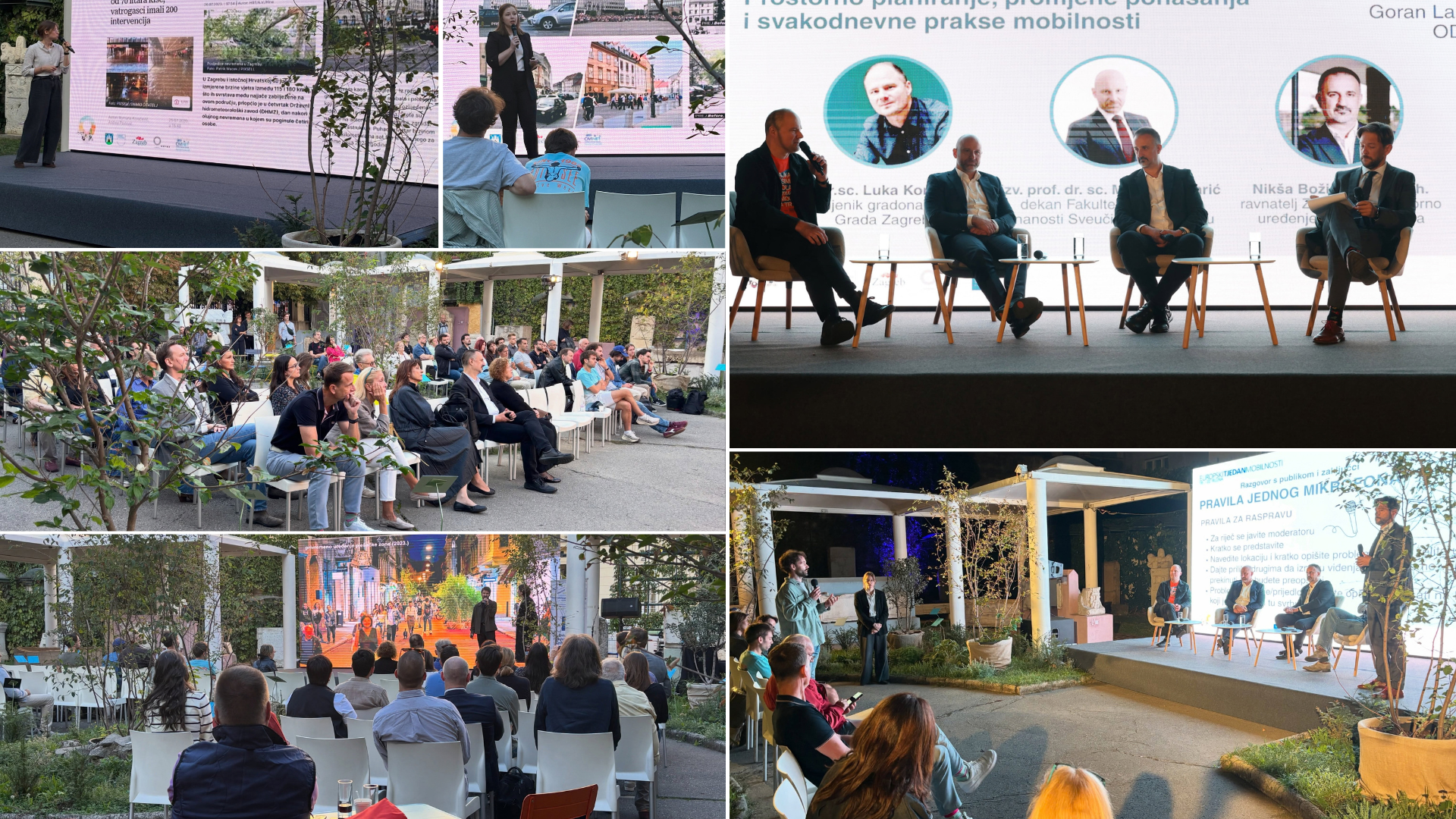
As part of European Mobility Week, on 21 September 2026, the event “Zagreb for All: Keeping Pace with the World” was held at the Lapidarium of the Archaeological Museum in Zagreb, focusing on the future of urban transport, the design of public spaces and sustainable forms of mobility.
The event was opened with an introductory presentation on planning climate-resilient cities by Lorena Zvonarić and Magdalena Ribarić from ODRAZ, who presented experiences and examples from Croatia, the region and Europe.
Presentation of the conceptual design for the new pedestrian zone
At the heart of the programme was the presentation of the conceptual design for the Masarykova – Teslina – Preradovićeva – Gajeva pedestrian zone.
The conceptual design, developed by the City of Zagreb Institute for Spatial Planning, was presented by Domagoj Mlinarić and Tea Truta. The project envisages transforming Masarykova and Teslina streets, as well as parts of Preradovićeva and Gajeva streets, into a unified, better designed and more people-friendly public space.
The aim of the project is to connect the area from Trg Republike Hrvatske to Trg Nikole Šubića Zrinskog, create new spaces for spending time, socialising and events, and further increase greenery in the city centre. The planting of more than 50 new trees and the creation of approximately 600 square metres of green space are planned, along with the renewal of underground infrastructure and comprehensive improvements to street-level public space.
Predstavljen je i participativni pristup planiranju te način na koji su građani uključeni u osmišljavanje budućeg izgleda i korištenja javnog prostora. Zainteresirani građani idejno rješenje mogu pogledati i na plakatima postavljenima u Masarykovoj i Teslinoj ulici. Detaljnije o projektu idejnog rješenja pješačke zone Masarykova – Teslina: https://www.zzpugz.hr/…/idejno-rjeenje-pjeake-zone..
Later, during the discussion with the audience, it was emphasised that improving public space does not end with its renovation. The way in which it will be maintained in the long term needs to be planned in advance, from cleaning and caring for greenery to maintaining street furniture. The responsibility of citizens for how they treat shared spaces and city property was also emphasised.
Public transport as the backbone of urban mobility
Following the presentation of the conceptual design, a discussion was held with Andro Pavuna, PhD, Head of the City Office for Municipal Self-Government, Transport, Civil Protection and Safety, on Zagreb’s strategic transport projects and their impact on future generations. During the discussion, Pavuna stressed that fast and reliable public transport must form the backbone of mobility in Zagreb, supported by safe pedestrian and cycling infrastructure, while cars cannot be given priority in urban planning. He also emphasised the need to involve citizens in changes in a timely manner and listen to their needs, while experts should develop concrete solutions that will make the city safer and more functional.
The significant potential of the existing railway infrastructure was also highlighted. By better integrating rail services with trams and buses, increasing service frequencies and coordinating timetables, railways could take on a considerably more important role in citizens’ everyday mobility.
This was followed by Luka Korlaet, PhD, Deputy Mayor of the City of Zagreb, who presented the activities undertaken and results achieved by the City of Zagreb to date in expanding and improving pedestrian zones.
The entire programme, including the discussion with Andro Pavuna, the round table and the discussion with the audience, was moderated by Goran Lampelj from ODRAZ.
Change requires quality dialogue with citizens
Following the Deputy Mayor’s presentation, a round table on spatial planning, behavioural change and everyday mobility practices was held. The discussion brought together Luka Korlaet, PhD, Associate Professor Marko Šoštarić, PhD, Dean of the Faculty of Transport and Traffic Sciences at the University of Zagreb, and Nikša Božić, Director of the City of Zagreb Institute for Spatial Planning.
It was emphasised that providing expert explanations for changes in transport and public space is not enough. Citizens need to be given the opportunity to understand and experience the benefits of these changes and to be involved in the process of identifying needs. At the same time, it is important to recognise the problem underlying individual requests and offer solutions that contribute to a safer, more accessible and more pleasant city.
Citizens should have the opportunity to express their needs and everyday experiences, while it is the role of experts to find appropriate and feasible solutions. Citizen involvement can help improve projects, but it does not mean that every professional and technical detail should be decided by direct vote.
Better integration of railways, trams and buses
Participants emphasised the need for better integration of railways, trams and buses, the coordination of timetables and the reorganisation of bus routes. Particular potential was identified in making better use of the existing railway infrastructure.
It was emphasised that a “metro” should primarily be understood as a level of service characterised by speed, high capacity, reliability and high frequency, rather than necessarily as an entirely new underground system. Such a level of service can be achieved through better use and integration of the existing railway and tram systems.
The tram was highlighted as an important part of Zagreb’s identity and the backbone of its public transport system. The need for greater awareness among all road users of the specific characteristics of tram traffic was emphasised, as was the need for solutions that would enable faster, safer and more reliable tram services.
New roads cannot solve congestion
It was concluded that new roads alone cannot resolve traffic congestion in the long term. They need to be planned alongside improvements to public transport, pedestrian and cycling infrastructure, and measures to reduce dependence on cars.
Increasing road capacity may provide initial relief, but over time it can attract additional car traffic and lead to congestion once again. Road projects should therefore be viewed as part of a broader transport system rather than as stand-alone solutions. The same applies to parking: building new garages and increasing the number of parking spaces cannot keep pace with the continuous growth in the number of cars in the long term.
It was also emphasised that major infrastructure projects should be based on transport modelling and feasibility studies. Before decisions are made, their long-term impacts on the transport system, the environment and overall mobility need to be assessed, and it should be determined whether the expected benefits provide greater value than the investment costs.
Transport and spatial planning must go hand in hand
It is equally important to coordinate spatial and transport planning. The discussion highlighted that some parts of Zagreb developed faster than the necessary infrastructure, which has left the City trying retrospectively to provide roads, schools, kindergartens, public transport and other services for areas that have already been developed.
More compact development and the activation of brownfield sites, namely underused former industrial and other urban areas, were highlighted as important alternatives to further urban expansion. Integrating these areas into the city’s development can enable better use of existing infrastructure and reduce the need for long daily journeys.
Particular attention was paid to Novi Zagreb, which, due to its urban structure, extensive green spaces, unfinished avenues and development reserves, requires a comprehensive approach to transport and spatial planning. Participants emphasised the need for its future development to be discussed separately and in greater detail.
Mobility focused on people’s needs
The event demonstrated that sustainable mobility is not about choosing between roads, railways, trams, buses, bicycles and walking, but about how to integrate them into a functional system focused on people’s needs.
Zagreb has significant potential in its existing railway and tram infrastructure, brownfield sites and opportunities for more compact development. New infrastructure projects should be based on transport models and assessments of long-term impacts, rather than solely on short-term increases in capacity.
Equally important are the continuous maintenance of public spaces, the timely involvement of citizens, and the gradual creation of conditions in which public transport, walking and cycling become practical, safe and everyday options.
The proposed development of the Masarykova – Teslina pedestrian zone is an important step towards a better designed, greener and more accessible centre of Zagreb.
The event was organised by the City of Zagreb in cooperation with ODRAZ.