

Young People Learn to Recognise Disinformation and Debate Climate Solutions
As part of the project “Resilient Community: Empowering Young People and Citizens to Verify Disinformation,” ODRAZ organised the “I’ll Believe It When I Verify It” workshops for primary and secondary school students, as well as two debates entitled “Climate Negotiation Simulation with Fact-Checking.” The activities focused on developing media and information literacy, critical thinking, and the responsible use and sharing of content, particularly content related to the environment and climate change. The workshops were designed and facilitated by Magdalena Ribarić from ODRAZ.
From Recognising Manipulation to Verifying Sources
The first workshop was held online on 21 April for students of the Makarska Vocational School, while the second took place on 25 May for students of Fran Krsto Frankopan Primary School in Zagreb. Using examples from the media, advertising, and social media, students learned how to recognise disinformation and manipulative content and how to verify sources and context.
The workshops covered greenwashing, climate disinformation, marketing manipulation, and the misuse of artificial intelligence and deepfake technology. Students adopted a simple rule: before sharing content, check the source, the evidence, and the context.
The workshops and debates demonstrated that verifying information is not merely a technical skill but also an essential prerequisite for responsible decision-making and meaningful participation in discussions about sustainable development and climate change. Through practical activities, students developed critical-thinking, argumentation, and public-speaking skills while learning to consider complex topics from environmental, social, and economic perspectives.
Autumn Workshops as Preparation for the Debates
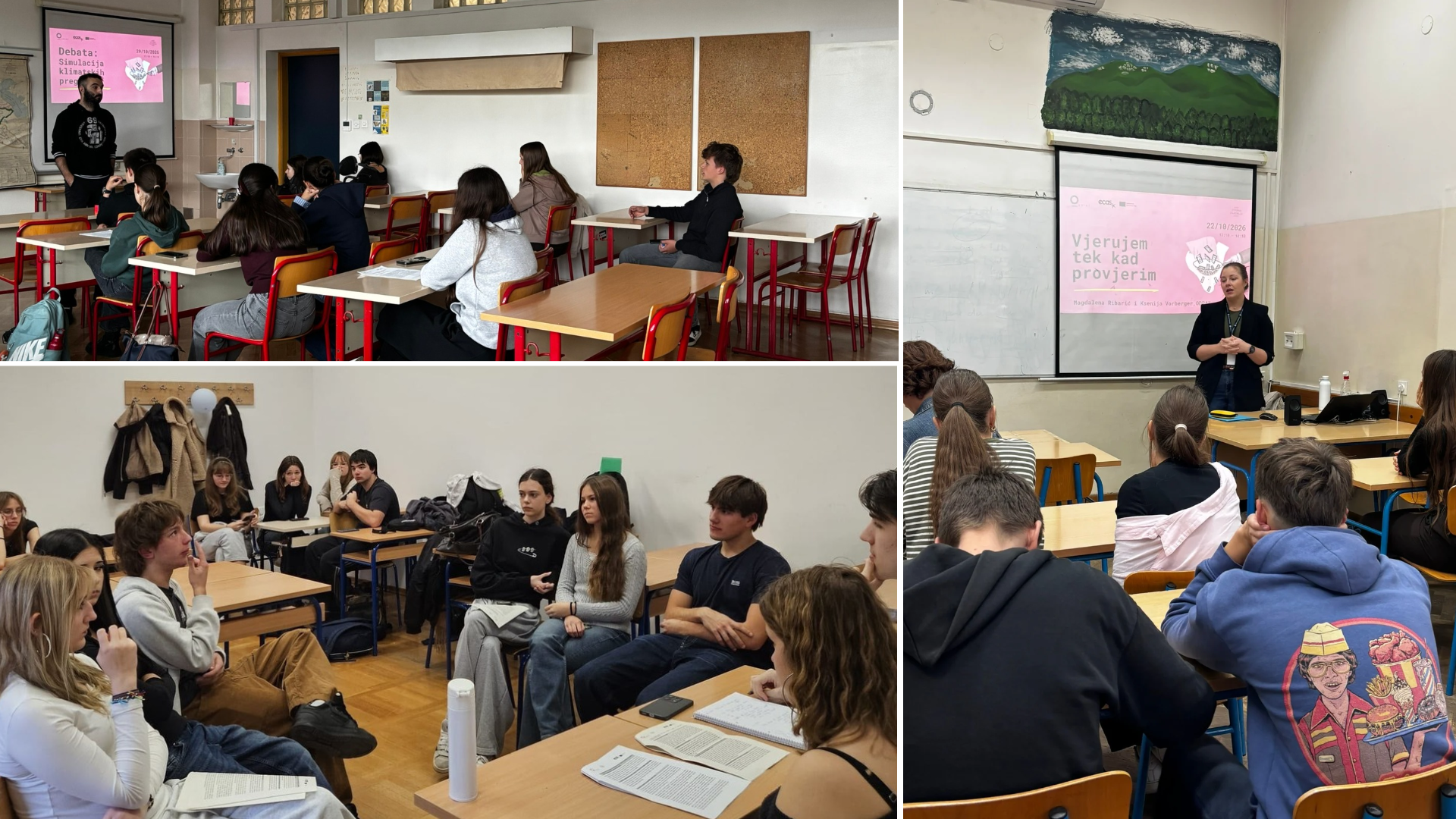
The autumn activities involved students from the debate clubs of the First Gymnasium and the Vladimir Prelog School of Science in Zagreb. During one workshop held at each school in October, students analysed climate disinformation, selective presentation of scientific data, and content created with the help of artificial intelligence. Using concrete examples, they learned how even factually correct data can lead to misleading conclusions when removed from its broader context. They also acquired practical guidelines for checking sources and assessing the credibility of content.
Students were introduced to the En-ROADS simulation model, which they used to explore how various measures and public policies can influence greenhouse gas emissions and rising global temperatures. They then applied their newly acquired knowledge and fact-checking methods when researching sources and preparing arguments for the debates.
Debate: Climate Negotiation Simulation
Following the workshops, students were asked to prepare for debates on the motion: “To achieve climate goals, society should prioritise investment in clean energy rather than conventional energy sources.”
Divided into teams representing advocates of clean technologies and conventional energy, students explored different stakeholder interests, checked the credibility of their sources, and prepared arguments concerning energy security, emission reductions, transition costs, employment, and the responsibilities of different stakeholders.
Their task was not to prove that one side was entirely right, but to defend their assigned position convincingly while also proposing solutions to climate change. This approach helped them understand the complexity of climate negotiations, in which environmental goals, economic interests, energy security, and social justice are closely interconnected.
Students’ Conclusions
At the First Gymnasium, students concluded that the energy transition requires timely action but must also be carefully planned and aligned with social and economic capacities. They particularly emphasised the importance of fairly distributing transition costs, protecting vulnerable groups, investing in education and reskilling, and sharing responsibility among citizens, governments, and large companies.
At the Vladimir Prelog School of Science, students stressed the need for a gradual, planned, and inclusive transition. They concluded that existing energy systems and new technologies should complement one another during the transition period to reduce emissions while maintaining a stable energy supply. They particularly highlighted the importance of investing in diverse energy sources, energy-storage systems, infrastructure, and support for lower-income households. The students also identified disinformation in the preparatory materials and did not use it during the debate.
The project is funded by the European Citizen Action Service (ECAS) as part of the EURECA Plus 2026 project, co-funded by the European Union.
The views and opinions expressed are solely those of the author and do not necessarily reflect the views of the European Union or ECAS. Neither the European Union nor ECAS can be held responsible for them.