

The cities of the future are being planned today
A webinar dedicated to the future of cities through the topics of spatial and urban planning, health, climate resilience, public spaces, citizen participation and available European support programmes was held on 9 July 2026. It was organised by ODRAZ in cooperation with the Association of Cities in the Republic of Croatia and brought together around 90 participants.
In the introduction it was emphasised that cities of the future are spaces planned around people. Health, everyday needs, mobility and the quality of public spaces are becoming increasingly important elements of spatial planning. At the same time, climate change, changing mobility patterns and growing pressure on public spaces require a more integrated approach to urban development.
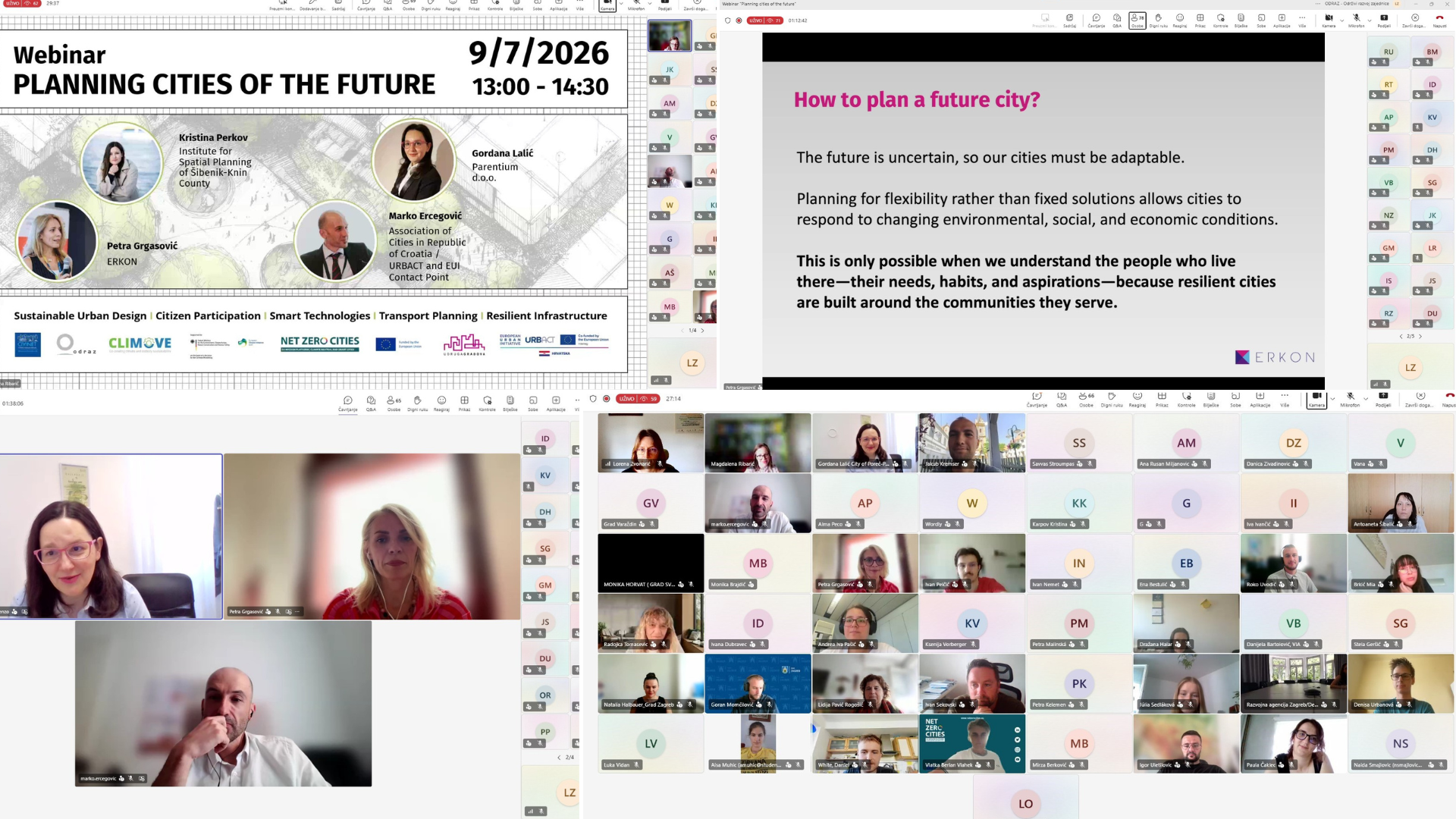
The first presentation was delivered by Kristina Perkov from the Institute for Spatial Planning of Šibenik-Knin County, on the topic “The Role of Spatial Planning in Implementing Urban Visions”. She emphasised that a vision alone does not change a city; it needs to be translated into policies, investments, institutional decisions and concrete spatial solutions.
Gordana Lalić from Parentium d.o.o. spoke about the connection between health, spatial planning and climate resilience in her presentation “Health, Spatial Planning and Climate: Integrated Planning for a Healthier Future”. Using the example of the City of Poreč, she showed how climate resilience can be understood within a broader framework of community health, social justice, environmental protection, inclusive planning, quality public spaces and sustainable mobility.
Petra Grgasović from ERKON delivered a presentation titled “Participation and Transformation: CITYWALK 2.0”. Using the example of Karlovac, she demonstrated how citizens’ needs can be mapped through surveys, focus groups, and the inclusion of vulnerable groups and other stakeholders. She placed particular emphasis on small but meaningful interventions in public space, the importance of political support, and the need for continuous testing, monitoring, adaptation and improvement of solutions.
The final presentation was delivered by Marko Ercegović from the Association of Cities in the Republic of Croatia, the national contact point for URBACT and the European Urban Initiative. He presented opportunities for European support to cities through programmes that encourage an integrated approach to urban challenges, stakeholder and citizen participation, transnational exchange of experience, capacity building and learning by doing.
It was concluded that cities of the future are already being shaped today through decisions on the design of public spaces, mobility, green infrastructure, climate resilience and citizen participation. The future of cities cannot be planned as one final solution, but rather as a flexible and adaptable process based on community needs, cooperation between different sectors and a willingness to learn through practice.
Key conclusions from the discussion
- Cities should not expect rapid and large-scale changes overnight; it is important to start with small steps and think long-term. One example is the Living Streets concept, which began with closing a street to motor traffic during weekends, later expanded seasonally, with further potential to develop into a pedestrian zone.
- Citizens are more likely to participate when they feel emotion, belonging and a personal connection to a certain space or issue
- Experts and planners may overlook important everyday barriers if they do not include those who experience them directly, especially vulnerable groups.
- Urban transformation is not a sprint, but a marathon; it requires patience, openness, willingness to learn and experimentation through smaller actions.
- Openness to different local contexts and learning through practical experience is essential
Webinar recording is available HERE.
The webinar is organised as part of the CLIMove project, funded by the European Climate Initiative (EUKI) of the German Federal Ministry for the Environment, Climate Action, Nature Conservation and Nuclear Safety (BMUKN)and as part of the NetZeroCities – Support to Cities project, funded by the European Union.
#NetZeroCities #NZCpodrškaHR #ClimateNeutralCities #ClimateChange #SustainableDevelopment #ClimateAction