

ODRAZ at the 2026 Civil Society Week: Final Event of the IDEU Project at the European Economic and Social Committee
Civil Society Week, the annual flagship event of the European Economic and Social Committee (EESC), took place in early March 2026 in Brussels. It is the largest gathering of civil society organisations at the European level, bringing together civil society representatives, policymakers, experts and stakeholders from across Europe to discuss key societal challenges and strengthen democratic participation. Civil Society Week serves as a platform for exchanging practices, dialogue and joint reflection on solutions for reinforcing democracy and social cohesion.
This year’s edition was particularly important for the IDEU – Inclusive Digital EU project, which is nearing its conclusion. As part of Civil Society Week, the final IDEU event was held on 4 March 2026, focusing on democratic resilience, media literacy and the role of civil society in the digital environment. Lidija Pavić-Rogošić participated on behalf of ODRAZ, a partner in the IDEU project.
Democracy Under Pressure: Why Societal Resilience Matters
The session addressed one of the most pressing issues of our time: how to strengthen the resilience of European societies in an era of growing global pressures, disinformation and polarisation.
At the beginning of the session, it was emphasised that societal resilience—built on trust, access to reliable information and active citizen participation—is the EU’s most important defence against trends that undermine democratic processes.
The crucial role of the media was emphasised, as they are essential for the functioning of democracy but face serious challenges: declining revenues and audiences, the dominance of unregulated digital platforms, political pressures, algorithmic biases and the growing influence of artificial intelligence. In addition, Russia’s aggression against Ukraine has opened a new chapter of information warfare aimed at weakening trust in institutions and deepening social divisions.
Media and Digital Resilience in Focus
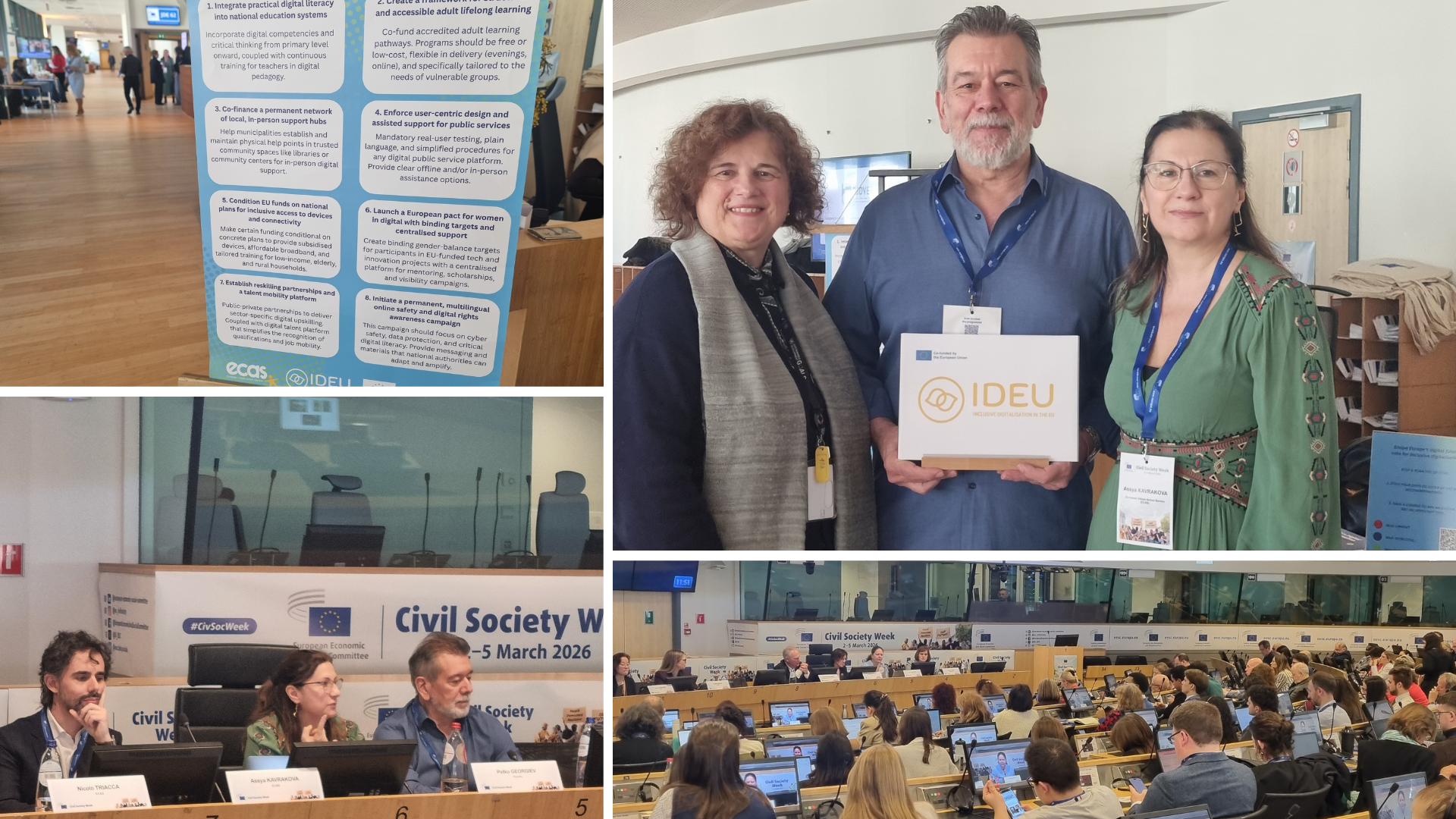
The event was moderated by Assya Kavrakova, Executive Director of ECAS and coordinator of the IDEU project. Speakers presented different aspects of digital and media resilience:
- Andris Gobiņš, EESC – social media, algorithms and the right to accurate information
- Petko Georgiev, ProInfo – the information battlefield and the fight for trust
- Arja Krauchenberg, EPA – strengthening resilience through cooperation between schools and families
- Sylvain Le Bon, Startin’Blox – digital tools for participatory democracy
- Nicolò Triacca, ECAS – citizens’ recommendations on digital transformation from six EU countries
There were more than 100 participants. Through interactive discussions, participants developed recommendations for strengthening democratic resilience and the role of civil society in the digital environment.
Contribution of the IDEU Project and the Role of ODRAZ
The IDEU project focuses on strengthening digital inclusion, media literacy and citizen resilience in six EU Member States. Through research, workshops and participatory processes, the project gathered valuable insights into how citizens perceive digital transformation and what barriers hinder their active participation.
The final event presented key results and recommendations:
- Introduce practical digital literacy in schools through curriculum reform and continuous teacher training, starting from primary education. (Belgium, Bulgaria, Croatia, Germany, Spain, Romania)
- Establish a European framework for digital lifelong learning with free or affordable programmes for adults, especially seniors, rural populations and vulnerable groups. (Belgium, Bulgaria, Croatia, Spain, Romania)
- Co-finance a network of local digital support centres in libraries and community spaces, offering in-person assistance. (Belgium, Bulgaria, Croatia, Romania)
- Make user centred design mandatory for public digital services, including plain language, user testing and offline support options. (Bulgaria, Croatia, Germany, Spain, Romania)
- Condition access to EU funds on national plans for providing devices and internet access to low-income households, seniors and rural users. (Belgium, Bulgaria, Croatia, Spain, Romania)
- Launch a European Pact for Women in Digital with binding targets and centralised support (mentoring, scholarships, campaigns). (Belgium, Bulgaria, Germany, Romania)
- Establish European partnerships for digital reskilling and a talent mobility platform to ease recognition of qualifications. (Belgium, Bulgaria, Croatia, Germany, Romania)
- Launch a permanent EU-wide campaign on online safety and digital rights, adapted to all Member States. (Croatia, Germany, Spain)
Lidija Pavić Rogošić engaged with visitors at the project stand, encouraging them to assess the proposed solutions and rank them by importance.
Conclusion: Civil Society as a Pillar of European Democracy
Civil Society Week 2026 once again demonstrated that civil society is an indispensable partner in safeguarding democracy, especially in the digital age. The IDEU project has provided concrete recommendations for empowering citizens and building more resilient societies, and ODRAZ is proud to have contributed to this important European effort.
The session concluded with shared messages on the need for continued investment in media literacy, digital inclusion and strengthening trust between institutions and citizens—foundations without which democracy cannot thrive.
#IDEU #ODRAZ #ECAS #CivilSocietyWeek2026 #EESC