

Interview with Cillian Lohan, President of the Civil Society Organisations Group in the EESC
Udruga.hr spoke with Cillian Lohan, President of the Civil Society Organisations’ Group, one of the three groups that make up the European Economic and Social Committee (EESC).
Cillian Lohan has long been recognised for his commitment to the circular economy, sustainability, civic participation, and strengthening participatory democracy in the European Union. During his mandate, expectations are high regarding the role that civil society can play in addressing key challenges such as the climate transition, social inclusion, digital transformation, and rebuilding trust in European institutions.
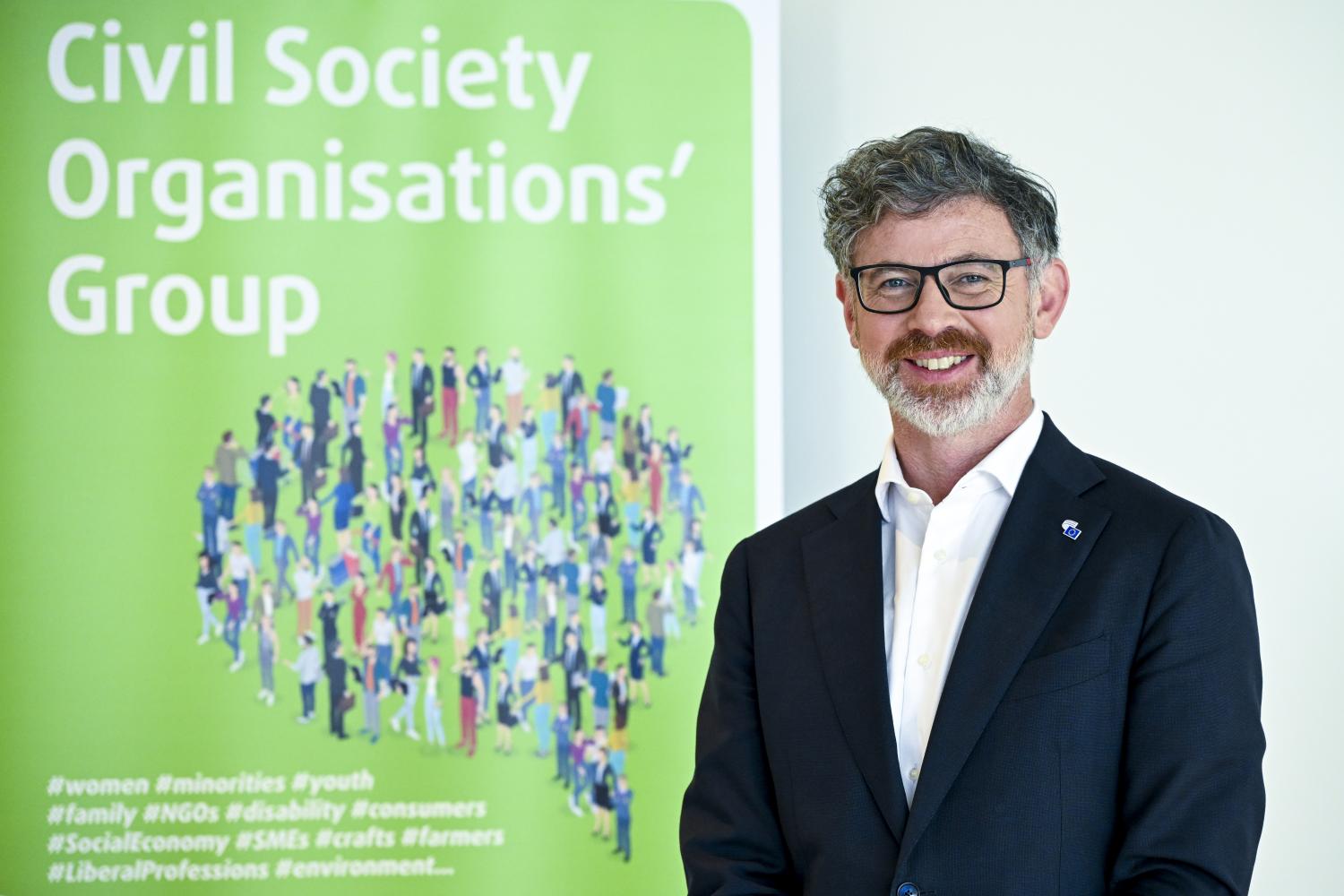
In this interview for Udruga.hr, you can read about his vision and priorities, as well as the initiatives he plans to implement to support a more resilient and participatory European Union.
Main priorities
His main priority as President of the Civil Society Organisations’ Group is to ensure that, as representatives of civil society organisations, the Group functions effectively and that its work has a meaningful impact on shaping EU policies. The Group has jointly developed a work programme for this mandate, focusing on broad and important issues such as democracy, peace, and the concept of sustainable and resilient communities. It will also advocate for the EU budget for the period 2028–2034, one that strengthens the European project and delivers concrete results for democracy, civil society, and social inclusion.
Our director, Lidija Pavić‑Rogošić, is Vice‑President of the EESC Civil Society Organisations’ Group and works closely with Cillian on implementing the work programme.
Cillian Lohan highlights the crucial role of civil society in today’s increasingly polarised political and social climate. As he notes, “civil society is the voice of reason in a world dominated by headlines and algorithms”.
Civil society at the centre of EU policymaking
Lohan emphasises that civil society organisations (CSOs) bring a unique, grounded perspective to EU decision‑making because they work directly with communities. Their long‑term, collaborative approach strengthens both democracy and social resilience. For this reason, the Group continues to advocate for participatory democracy and the systematic involvement of CSOs across all EU policy areas.
Rebuilding trust between EU institutions and citizens
The EESC, grounded in the EU Treaties, serves as a structured platform for dialogue. Through its 329 members, it reaches over 90 million people, “one in five EU citizens”. The Group is currently preparing major participatory events in Cyprus and Ireland to bring citizens, national organisations, and EU institutions together to discuss democracy, resilience, and European values.
The Group also promotes intergenerational dialogue, including youth roundtables on climate and sustainability, ensuring young people have a direct voice in EU debates.
Protecting democratic space and fundamental rights
Lohan warns that civil society can only function effectively if it has access to independent, accessible funding and the freedom to criticise and propose alternatives. The Group supports the upcoming AgoraEU programme, which calls for increased EU funding for culture, media, and civil society from 2028 to 2034.
Within the EESC, the Fundamental Rights and Rule of Law (FRRL) Group monitors the situation in Member States, producing fact‑based reports and engaging with national CSOs to highlight threats to rights and democratic standards.
Ensuring a fair and inclusive green transition
The interview stresses that climate impacts – fires, floods, water scarcity and air pollution – are already affecting all Member States. While the European Green Deal aims to modernise the economy and protect society, past policies have sometimes disproportionately burdened vulnerable groups. Lohan argues that those who have profited most from environmental harm should contribute most to financing the transition.
The Group will continue to push for the Green Deal and sustainable development to return to the top of the EU agenda. It will advocate for practical solutions such as circular economy models (repair, reuse, sharing, and recycling) to build prosperity within communities. Lohan will serve as rapporteur for the upcoming EU Circular Economy Law, reflecting the Group’s recognised expertise in this field.
A vision for his mandate
Lohan hopes his mandate will contribute to building a European Union that “feels like it belongs to all of us”—a Union confident in its strengths, committed to democracy and the rule of law, and resilient in the face of crises. He calls on citizens to shape the future together through civil society, ensuring a fair, inclusive and hopeful Europe for current and future generations.
#EESC #CivilSociety #CillianLohan # CivilSociety OrganisationsGroup