

The future of rural development after 2027: Key messages and EESC recommendations presented in Tuhelj
The conference organised by the LEADER/CLLD Thematic Working Group of the CAP Network of the Ministry of Agriculture, Forestry and Fisheries brought together more than 100 participants from across Croatia and abroad. Over three days (23-25 March 2026), participants discussed experiences from the previous programming period and the future of rural development after 2027.
Day One: Review of LEADER/CLLD Implementation
Participants were presented with evaluations of LEADER and CLLD implementation in 2014–2020, with emphasis on lessons learned and areas for improvement.
“Good practices exist — now is the time to strengthen them and make them systematic.”
The day concluded with an interactive session exploring opportunities to improve the bottom‑up approach in which Lidija Pavić-Rogošić took an active role.
Day Two: Strategic Dialogue and the European Perspective
The central day of the conference was opened by Dr. Silvio Šimon from Ministry of Agriculture, Forestry and Fisheries, who highlighted the importance of the LEADER/CLLD Thematic Working Group and the key role of LAGs.
“LAGs are the link between national and local policies — and the key to growth and prosperity in rural areas.”
Messages from the European Parliament and the Rural Pact
Members of the European Parliament Karlo Ressler and Marko Vešligaj emphasised the importance of integrating EU policies and the role of local actors.
“LEADER remains one of the most valuable tools for involving communities in shaping policies.”
This was followed by an address from Dubravka Lipovac Pehar, Member of the Croatian Parliament, Chair of the Committee on Regional Development and EU Funds, and member of the Parliament’s Committee on Agriculture, who called for strengthening cooperation.
Pawel Krzeczunowicz from the Rural Pact Support Office spoke about its importance and presented how the Long-Term Vision for Rural Areas and the Rural Pact are being implemented in the Member States. He explained what the Rural Pact is and how to join it.
The New MFF and the Future of LEADER
European Commission representative Iwona Lisztwan presented the legal proposals for LEADER 2028–2034.
“The new programming period brings an opportunity for stronger, more integrated and more effective local strategies.”
Lidija Pavić Rogošić presented the EESC recommendations, while Radim Sršen shared Czech experiences and perspectives on rural development after 2028.
Key Messages from the EESC:
Lidija Pavić-Rogošić highlighted that Europe cannot achieve a fair, green and digital transition without strong and vibrant rural areas. Rural communities face demographic decline, reduced services and structural disadvantages, making it essential to safeguard the fundamental “right to stay” and ensure predictable, dedicated support in the EU budget after 2027. The EESC stresses the importance of a holistic, place‑based approach, the strong role of local actors and civil society, and the need to reinforce LEADER and CLLD as key community‑led development tools. Rural development funding must remain clearly earmarked, stable and accessible, with simplified procedures and reduced administrative barriers.
Rural proofing must become a mandatory part of EU policymaking, while cohesion policy must retain its role as the foundation of European solidarity and territorial balance. In the context of the announced National and Regional Partnership Plans (NRPPs), the EESC emphasises the need to preserve the partnership principle and ensure the involvement of local and regional actors, social partners and civil society in all stages of the process. Europe’s future will be sustainable and cohesive only if rural areas can thrive — which is why the EESC calls for stronger funding, simpler rules, deeper participation and better coordination, ensuring that no region and no citizen is left behind.
Digital Transition and Smart Villages
Speakers from ELARD, the EU Smart Villages Network and the OECD highlighted the importance of digitalisation, innovation and evidence‑based policymaking.
“Rural proofing must become the standard — not the exception.”
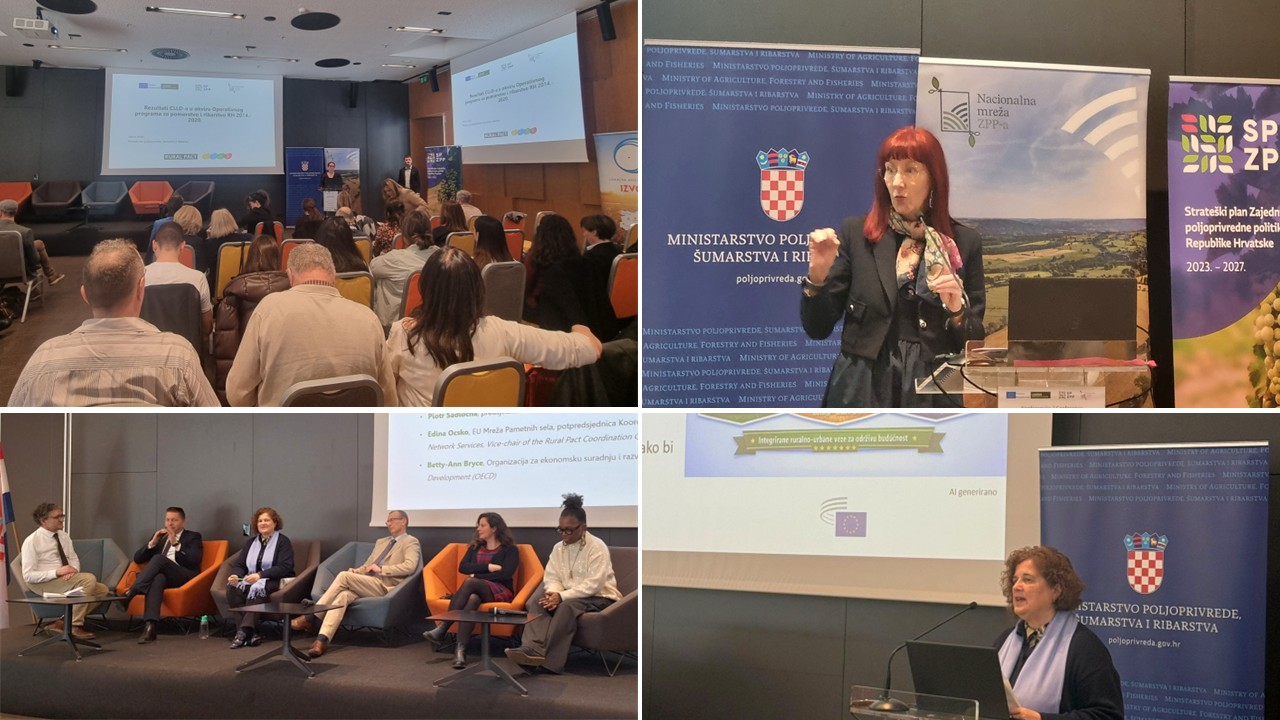
In the continuation of the event, the focus shifted to a joint dialogue on the position of rural areas within EU and Croatian policies after 2027. Lidija Pavić‑Rogošić was one of the panelists in a discussion moderated by Pawel Krzeczunowicz.
Generational Renewal and Territorial Tools
The second part of the day provided an overview of the new MFF and CAP, with a focus on generational renewal.
Jakša Puljiz (IRMO) presented Croatian experiences with EU territorial tools, Aleksandar Lukić discussed development indicators of rural areas, and Branko Logarić (NZRCD) highlighted the importance of joint investments by LAGs and the Foundation.
Examples of Good Practice
Eduard Trepat Deltell presented the Catalan Rural Agenda 2030 and its model of shared governance.
Closing Message of Day Two
Željka Gudelj Velaga from the Ministry of Agriculture, Forestry and Fisheries emphasised in her address the importance of transforming rural areas and creating conditions that enable young people to remain in their communities, supported by concrete rural development policies. She also highlighted the valuable role of LAGs, which are best positioned to identify local needs and challenges and, through long‑standing cooperation with policymakers, make their communities more vibrant, connected and attractive places to live. She concluded by noting that this conference has laid a strong foundation for further cooperation and expressed hope for future partnerships with all LEADER stakeholders.
“New times require new models of cooperation — and LEADER is a tool we must continue to strengthen.”
Conference Conclusions
The conference provided:
- an overview of lessons learned from the previous period
- examples of good practice
- insights into the future of the CAP and rural development
- confirmation of the essential role of the LEADER approach in future programming periods.
“Integrated territorial approaches and bottom‑up methods remain key to vibrant, connected and resilient rural areas.”
The event served as a platform for joint reflection on EU policies for rural areas after 2027, with a particular emphasis on the role of LEADER/CLLD in the new MFF and in national and regional partnership plans.”
#RuralDevelopment #LEADERCLLD #RuralProofing #MFF #EESC